Cups to Grams for Calorie Counting: What a Cup of Food Weighs
A cup measures space, not weight, so one cup holds a different number of grams for every food. In USDA data, one cup of cooked white rice weighs 158 g and carries 205 kcal. One cup of dry white rice weighs 185 g and carries 675 kcal. One cup of dry rolled oats weighs 81 g and carries 307 kcal. If you only have a cup, say which food, whether it was dry or cooked, and how it was packed. If you have a scale, use grams.
Key takeaways
- A cup is a volume. The grams in it depend on the food, its state (dry, cooked, chopped) and how tightly it sits.
- The same food, dry and cooked, differs by 1.7 to 3.3 times in calories per cup (table 2).
- One food has no fixed cup either: King Arthur Baking puts all-purpose flour at about 120 g fluffed, scooped and leveled, and up to 160 g packed.
- Milliliters need the food's own density, not 1 mL = 1 g.
- For foods you eat often, weigh your own cup five times and keep the average.
- A cup is good enough for leafy vegetables. It is not for flour, oils, nut butters and dry grains.
What is the short answer for counting calories from a cup?
Treat a cup as a rough guide to weight and a gram figure as the number to count. Three rules cover most meals:
- Weigh when you can. A kitchen scale turns "a cup" into grams in one step, and grams multiply cleanly by a calorie value per 100 g.
- Otherwise name the food, the state and the packing. "1 cup cooked white rice, level" gives a number you can look up. "A cup of rice" does not.
- Weigh your own cup once. One careful weighing gives you a personal conversion (see the home test).
Every gram and calorie figure here comes from USDA FoodData Central, SR Legacy data type, read from the downloaded tables on 2026-10-16. USDA lists SR Legacy as a final release (April 2018). Calories per cup are our arithmetic: grams per cup x kcal per 100 g / 100. Per-food numbers live on the calories-by-food pages.
What is a cup, exactly?
There is more than one cup:
- US label cup: 240 mL. For nutrition labeling, federal rules state that "a cup means 240 mL", a tablespoon 15 mL and a teaspoon 5 mL (21 CFR 101.9(b)(5)(viii)).
- US customary cup: 236.588 mL. NIST lists the US cup as 2.365882E-04 cubic meters, which is 236.5882 mL. Its tablespoon is 14.78676 mL.
- Your own cup. A mug, a rice-cooker cup or a glass can be any size.
The first two differ by 240 / 236.588 = 1.0144, or 1.4 percent. On a 205 kcal cup of rice that is about 3 kcal. This is the smallest error in the chain. The state of the food and the packing move the answer by tens or hundreds of calories.
The FDA says a Nutrition Facts serving size is "provided in familiar units, such as cups or pieces, followed by the metric amount" in grams. FoodData Central does the same: each portion record pairs a cup description with a gram weight. The USDA tables we read do not state which cup size they assume.
Why does a cup weigh different amounts?
Three things set the weight of a cup, and none of them is the cup.
- Density of the food. A cup of honey weighs 339 g and a cup of raw spinach 30 g, a gap of 11 times, because honey is dense and spinach leaves pack loosely.
- Shape and size of the pieces. From one USDA record for dry enriched pasta, a cup of penne weighs 95 g, elbows 122 g and shells 64 g.
- Packing. How hard you press, tap or heap changes how many grams fit.
King Arthur Baking writes that "a cup can hold up to 160 grams of all-purpose flour" when the flour is condensed, and "around 120 grams" if you fluff, scoop and level. Our arithmetic, using 364 kcal per 100 g (USDA FDC 168894):
Worked example: one cup of all-purpose flour, two ways of filling it.
- Fluffed and leveled:
120 g x 364 kcal / 100 g = 437 kcal - Packed:
160 g x 364 kcal / 100 g = 582 kcal - Difference:
582 - 437 = 145 kcal, and160 / 120 = 1.33, so 33 percent more flour
Same cup, same flour, a 145 kcal swing.
We did not find a measured study of how much a scooped cup varies across home cooks, so we give no typical figure.
Careful sources also disagree on the "normal" cup. USDA lists 125 g for enriched all-purpose flour and King Arthur 120 g, a 4 percent gap (125 / 120 = 1.04). Rolled oats spread wider. USDA's dry rolled-oat record gives 81 g per cup. King Arthur's chart lists 89 g for old-fashioned or quick-cooking oats and 113 g for its own rolled oats. From 81 g to 113 g is 113 / 81 = 1.40, a 40 percent spread for what a shopper calls "a cup of oats". Different products explain some of it. A recipe that says "a cup of oats" does not say which.
How many grams are in a cup of common foods?
Table 1 lists 22 USDA cup records across 15 foods. The grams are exactly as USDA states them. Calories are our arithmetic.
| Food and state (FDC id) | Portion as USDA states it | Grams | kcal |
|---|---|---|---|
| White rice, raw (168877) | 1 cup | 185 | 675 |
| White rice, cooked (168878) | 1 cup | 158 | 205 |
| Brown rice, cooked (169704) | 1 cup | 202 | 248 |
| Rolled oats, dry (173904) | 1 cup | 81 | 307 |
| Rolled oats, cooked with water (173905) | 1 cup | 234 | 166 |
| Spaghetti, dry (169736) | 1 cup spaghetti | 91 | 338 |
| Spaghetti, cooked (169737) | 1 cup spaghetti not packed | 124 | 196 |
| Spaghetti, cooked (169737) | 1 cup spaghetti packed | 151 | 239 |
| Elbow macaroni, dry (169736) | 1 cup elbows | 122 | 453 |
| Elbow macaroni, cooked (169737) | 1 cup elbows not packed | 120 | 190 |
| Quinoa, uncooked (168874) | 1 cup | 170 | 626 |
| Quinoa, cooked (168917) | 1 cup | 185 | 222 |
| Lentils, raw (172420) | 1 cup | 192 | 676 |
| Lentils, cooked (172421) | 1 cup | 198 | 230 |
| Chickpeas, cooked (173757) | 1 cup | 164 | 269 |
| Broccoli, raw (170379) | 1 cup chopped | 91 | 31 |
| Spinach, raw (168462) | 1 cup | 30 | 7 |
| Milk, whole 3.25% (172217) | 1 cup | 244 | 149 |
| Olive oil (171413) | 1 cup | 216 | 1,909 |
| Peanut butter, smooth (174266) | 1 cup | 258 | 1,543 |
| Wheat flour, white, all-purpose (168894) | 1 cup | 125 | 455 |
| Sugar, granulated (169655) | 1 cup | 200 | 774 |
Table 1. Grams from USDA FoodData Central SR Legacy portion records (read 2026-10-16). Calories: grams x kcal per 100 g / 100, rounded to whole kcal. Cooked spaghetti packed: 151 / 124 = 1.22, so 22 percent more than not packed.
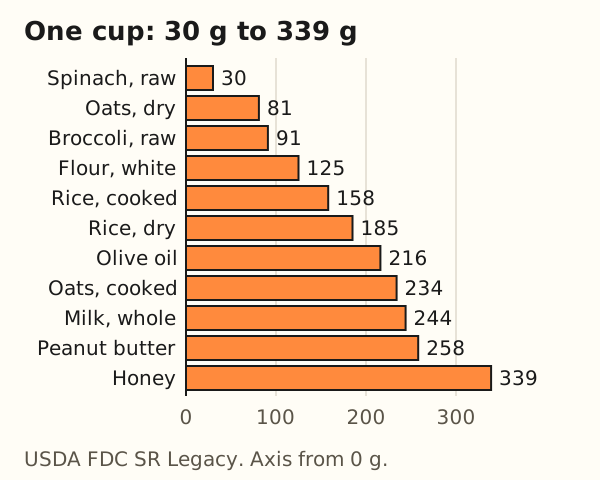
Calories per cup follow calories per gram, not weight alone. Milk is the heavier cup (244 g against 216 g), yet olive oil has 12.8 times the calories per cup (1,909 / 149), because oil carries 884 kcal per 100 g and milk 61.
The oats page goes deeper on one food, and the same data exists for white rice, pasta and quinoa. Brown rice at 202 g per cooked cup, against 158 g for white, shows that one word, "rice", spans different cups.
Why does a dry cup have up to 3.3 times the calories?
Rice, oats and pasta absorb water as they cook, so cooked food weighs more and has fewer calories per gram. The physics, and how to weigh a whole pot, are in the raw vs cooked guide. Here is only what it does to a cup.
| Food (FDC ids) | Dry cup (g / kcal) | Cooked cup (g / kcal) | Ratio |
|---|---|---|---|
| White rice (168877, 168878) | 185 / 675 | 158 / 205 | 3.3 |
| Rolled oats (173904, 173905) | 81 / 307 | 234 / 166 | 1.8 |
| Spaghetti (169736, 169737) | 91 / 338 | 124 / 196 | 1.7 |
| Elbow macaroni (169736, 169737) | 122 / 453 | 120 / 190 | 2.4 |
Table 2. Ratio = dry kcal per cup divided by cooked kcal per cup: 675 / 205 = 3.3, 307 / 166 = 1.8, 338 / 196 = 1.7, 453 / 190 = 2.4. Cooked pasta uses the "not packed" cup.
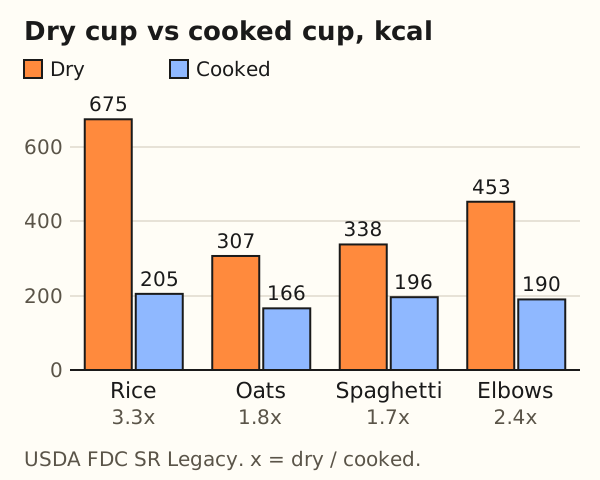
A cup of cooked oatmeal (234 g) weighs almost three times a cup of dry oats (81 g), because oats absorb water and swell. Elbows look different: 122 g dry and 120 g cooked, nearly the same weight, but 453 against 190 kcal. Pasta shapes pack differently dry and cooked, which is why USDA lists a separate cup weight per shape.
If your AI hears "a cup of rice" and assumes dry, it may count 675 kcal for a 205 kcal plate. The state is the one fact a cup cannot carry.
How do you turn milliliters into grams?
A milliliter is a volume, like a cup. Water is about 1 g per mL (USDA's 237 g cup works out to 1.00 g per mL). For other foods the grams in 1 mL are the food's density, and it varies a lot. The USDA cup record gives a workable density. Divide the grams in a cup by the cup's volume (we use NIST's 236.588 mL):
| Food (FDC id) | Grams per cup | g per mL | 250 mL weighs (g) |
|---|---|---|---|
| Honey (169640) | 339 | 1.43 | 358 |
| Milk, whole (172217) | 244 | 1.03 | 258 |
| Water, bottled (174158) | 237 | 1.00 | 250 |
| Olive oil (171413) | 216 | 0.91 | 228 |
| White rice, raw (168877) | 185 | 0.78 | 195 |
| White rice, cooked (168878) | 158 | 0.67 | 167 |
| Rolled oats, dry (173904) | 81 | 0.34 | 86 |
| Spinach, raw (168462) | 30 | 0.13 | 32 |
Table 3. g per mL = grams per cup / 236.588 (158 / 236.588 = 0.67). Last column = 250 x g per mL. For solids this is a bulk density: it includes the air between pieces and moves with packing.
The spread is wide: 250 mL is 358 g of honey and 86 g of dry oats. Olive oil at 0.91 g per mL agrees with its tablespoon: 13.5 g in 14.787 mL is 0.913.
Now the search question: how many calories are in 250 mL of cooked rice? Cooked white long-grain rice is 130 kcal per 100 g and a cup is 158 g (FDC 168878). Two ways to treat the 250 mL give close answers:
Worked example: 250 mL of cooked white rice.
- With the 240 mL label cup:
250 / 240 = 1.04 cups, then1.04 x 158 g = 164.6 g, then164.6 x 130 / 100 = 214 kcal - With the 236.588 mL customary cup:
250 / 236.588 = 1.057 cups, then1.057 x 158 g = 167.0 g, then167.0 x 130 / 100 = 217 kcal - If your rice is packed 10 percent heavier:
164.6 x 1.1 x 1.30 = 235 kcal
So about 215 kcal, up to about 235 kcal if the rice is packed, for plain rice cooked in water.
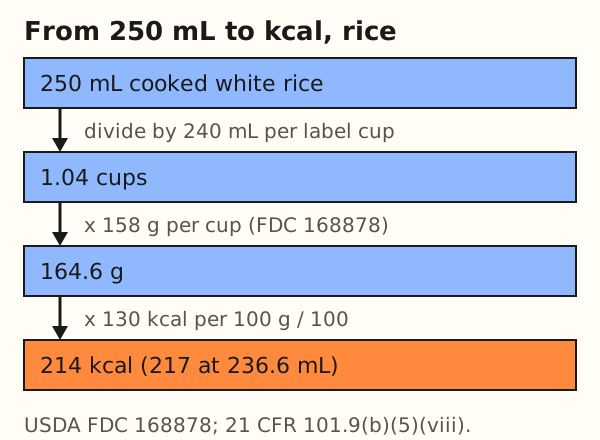
This is an approximation, not a USDA value. USDA has no record for "250 mL of cooked rice". Also, 250 mL is 1.04 label cups and 1.06 customary cups, so a recipe in 250 mL and a recipe in "1 cup" are close but not the same.
What about spoons and scoops?
A tablespoon works like a very small cup. For high-calorie foods the error per spoon is large because each gram carries many calories. USDA lists these spoon portions:
| Food (FDC id) | Portion as USDA states it | Grams | kcal |
|---|---|---|---|
| Olive oil (171413) | 1 tablespoon | 13.5 | 119 |
| Butter, salted (173410) | 1 tbsp | 14.2 | 102 |
| Peanut butter, smooth (174266) | 2 tbsp (we halve it) | 16 | 96 |
| Honey (169640) | 1 tbsp | 21 | 64 |
| Sugar, granulated (169655) | 1 tsp | 4.2 | 16 |
Table 4. Spoon portions from USDA FoodData Central SR Legacy (read 2026-10-16). kcal = grams x kcal per 100 g / 100: 13.5 x 884 / 100 = 119, 14.2 x 717 / 100 = 102, 16 x 598 / 100 = 96, 21 x 304 / 100 = 64, 4.2 x 387 / 100 = 16.
- Level versus heaped. A heaped spoon holds more than a level one. We did not find a measured figure for how much more, so we give none. Count a heaped spoon as more than Table 4 shows.
- Oil. At 119 kcal a tablespoon, a pour of 2 tablespoons is 238 kcal (2 x 119), more than a cup of cooked rice. Oil is a common hidden item in a mixed meal.
- Scoops. Protein, coffee and ice-cream scoops each have their own size. Use the grams printed on the package for the scoop supplied.
What does an AI do with "a cup of rice"?
An AI has to guess the state and the packing, and for the GPT models in one benchmark, household amounts did worse than grams. The NutriBench benchmark (Hua and colleagues, arXiv:2407.12843) holds 11,857 meal descriptions built from real dietary survey data. Among them, the authors compiled 5,532 descriptions with natural servings (like "a cup of rice") and the same 5,532 with amounts in grams, from US survey data (What We Eat in America).
The paper scores carbohydrates, not calories. An estimate counts as correct if it lands within 7.5 g of the true carbohydrate total (Acc@7.5). It is a different yardstick from kcal.
The authors report that most models had a higher mean absolute error with natural servings ("a cup of rice") than with metric ones ("80 g of rice"), and that GPT-4o and GPT-4o mini did notably better with metric amounts. One figure caption in the same paper says the opposite for non-GPT models, so we rely on the GPT-4o result only. In the paper's side comparison with nutritionists (72 meal descriptions), Table 10 reports GPT-4o with step-by-step prompting within range on 63.16 percent of the metric descriptions and 57.58 percent of the natural ones. That is 5.6 points apart (63.16 - 57.58) on roughly 70 meals, a hint and not a rate.
A household measure makes the AI choose a state and a packing without telling you. How to phrase a whole plate is covered in how to count calories with ChatGPT. The point here is narrow: amounts in grams remove one guess.
How do you test your own cup in two minutes?
You do not need to trust a table to learn your own error. You need a scale.
- Fill your usual cup the way you normally do. Do not try to be careful.
- Weigh the food with the cup tared off. Write the grams down.
- Empty the cup and repeat four more times.
- Compute the mean, the range (largest minus smallest) and the range divided by the mean.
Cook rice or oatmeal first. Table 5 shows what the record could look like. The five weights are illustrative, not measured by us.
| Weighing | Grams | kcal |
|---|---|---|
| 1 | 152 | 198 |
| 2 | 163 | 212 |
| 3 | 171 | 222 |
| 4 | 148 | 192 |
| 5 | 158 | 205 |
| Mean | 158.4 | 206 |
| Range | 23 | 30 |
Table 5 (illustrative, not a measured record). kcal = grams x 130 / 100 for cooked white rice (FDC 168878). Mean = 792 / 5 = 158.4 g. Range = 171 - 148 = 23 g, and 23 / 158.4 = 14.5 percent of the mean.
In this example the cup averages 158 g, which happens to match USDA's 158 g, and the lightest and heaviest cups differ by 30 kcal. Your numbers will differ. A small range means a steady cup. A large one means you should weigh instead of scooping. Either way you now have your number, not the table's. Repeat the test for the two or three foods you log most.
When is a cup good enough?
A cup error matters in proportion to the calories in the cup. Say you misjudge a cup by 20 percent (an illustrative figure, chosen for the arithmetic). The same 20 percent costs very different amounts:
- Raw spinach: 30 g x 23 kcal / 100 g = 7 kcal per cup. 20 percent is 1.4 kcal.
- Cooked white rice: 205 kcal per cup. 20 percent is 41 kcal.
- Dry rolled oats: 307 kcal per cup. 20 percent is 61 kcal.
- White all-purpose flour: 125 g x 364 / 100 = 455 kcal per cup. 20 percent is 91 kcal.
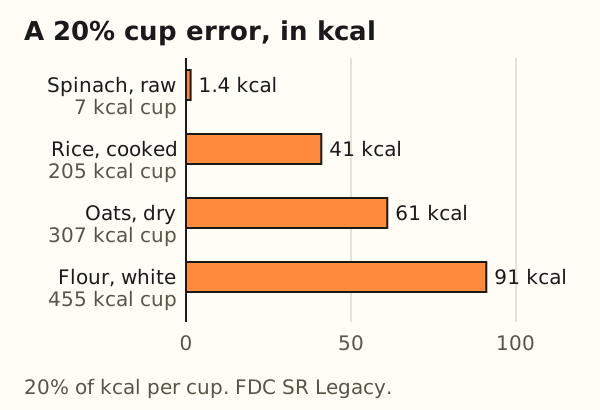
The flour error is 65 times the spinach error (91 / 1.4). A day with a few cups of leafy greens and one cup of dry oats has its error almost entirely in the oats. The working rule: spend your effort where the calories are. Use a cup for leaves, broth and raw vegetables. Use a scale for grains, flour, oils, nut butters, cheese and granola.
How do you tell your AI an amount in cups?
Give it the food, the state, the amount and how you filled the cup. If you did the home test, give the grams. These patterns work in any chat:
- "1 cup cooked white rice, level, about 158 g."
- "Half a cup of dry rolled oats, about 40 g, cooked in water."
- "2 tablespoons olive oil, level."
- "250 mL cooked rice. Assume 0.67 g per mL and tell me the grams you used."
The last line asks the AI to show its conversion. If it used 185 g for a cooked cup of rice, it picked the dry weight. For a longer check of any answer, see how to check an AI calorie estimate.
Where does Remembite fit?
Your AI does the math. Remembite keeps the record. You tell Claude what you ate, cups included, and Claude works out the macros. Remembite stores each meal and draws the charts. For foods it can confidently match to a USDA-based reference, Remembite compares the number it receives with that reference. If the number sits far away, it does not save the meal. It sends a question back to your AI, which asks you to confirm or correct it. A cup of dry rice logged at the calories of a cooked cup is the kind of gap this check is meant to surface. It cannot know which state you ate, so you still say it.
Your AI does the conversion and the math, and the numbers Remembite saves are the ones your AI sends. When Remembite checks a number against a USDA-based reference, it can read common household amounts such as cups for foods it can confidently match. Still tell your AI the food, the state and the grams or cup size. Free to start. Any paid plan will be announced here before it begins. You can create a free account and add Remembite to Claude as a custom connector. See the methodology for how references are used. Remembite is not affiliated with Anthropic, OpenAI or King Arthur Baking.
Frequently asked questions
How many grams is one cup of cooked rice?
USDA lists 158 g for a cup of cooked white long-grain rice (FDC 168878) and 202 g for cooked brown long-grain rice (FDC 169704). Your own cup can differ with packing, so weigh it once if you eat rice often.
Is 250 mL the same as one cup?
No. A US label cup is 240 mL and a US customary cup is 236.588 mL, so 250 mL is 1.04 or 1.06 cups (250 / 240 and 250 / 236.588).
Why do two sources give different grams for a cup of flour?
The number depends on packing and on the product. USDA lists 125 g for enriched all-purpose flour. King Arthur Baking lists 120 g and says a packed cup can hold up to 160 g. When a recipe or an AI quotes a cup of flour, ask for grams.
Estimates, not medical advice. How the numbers work.
Start your own record
Create a free account with your email, then add Remembite to Claude. Want to look first? Watch Claude log a sample day, no account needed.