How to Calculate Calories in a Mixed Meal
To calculate the calories in a mixed meal, work out each food on its own, then add the results. Give every food an amount and, for rice, pasta or meat, say whether it was cooked or raw. The least certain amount drives most of the error, so firm up that one first.
How do you add up a meal item by item?
Split the meal into foods and write down three things for each: the food, the amount, and the state it was in when you measured it. Each item's calories are its grams times the calories per 100 g of the matching USDA record, divided by 100. The meal is the sum.
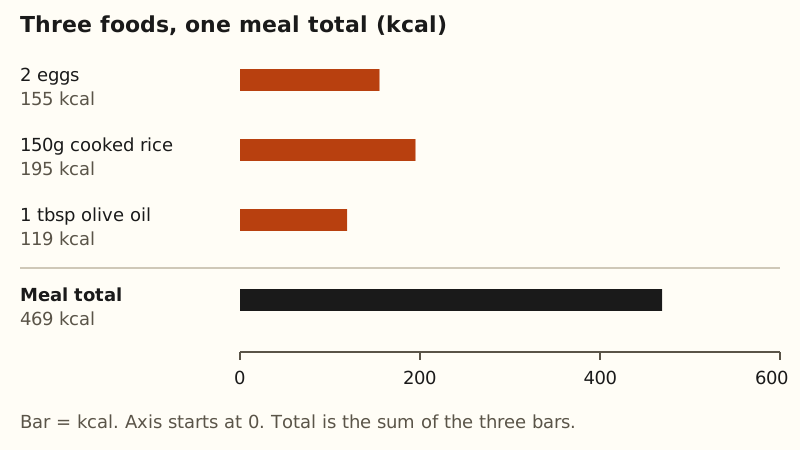
Take "2 eggs, 150 g cooked rice and 1 tbsp olive oil". The per 100 g values come from the USDA records. The last column is my arithmetic:
| Item | Amount | kcal per 100 g | kcal |
|---|---|---|---|
| 2 large eggs, hard-boiled | about 100 g (50 g each) | 155 | 155 |
| Cooked white rice | 150 g | 130 | 195 |
| Olive oil | 1 tbsp, 13.5 g | 884 | 119 |
| Meal total | 469 |
155 + 195 + 119 is 469. You can check the egg and rice values on the eggs and white rice pages. Olive oil has no page here: its value is USDA SR Legacy, FDC 171413, with a tablespoon weighing 13.5 g.
Which item sets the error?
The largest and least certain one. In the meal above, the rice is weighed, so 195 kcal is the more certain figure. Say "a bowl of rice" instead and the white rice page lists small, medium and large bowls at 195, 325 and 455 kcal. That gap is 260 kcal, more than twice the whole oil line.
You do not need to weigh everything. Weigh the item that is largest and least certain, usually rice, pasta or oil, and count the rest. For more on where error comes from, see how big the error is in calorie counts.
How do you say an amount so it can be added?
State it the way a scale would, or as a measure with a known weight. Here is the same cooked rice, said four ways, with the values from the white rice page:
| What you say | Weight | kcal |
|---|---|---|
| 150 g cooked rice | 150 g | 195 |
| 1 cup of cooked rice | 158 g | 205 |
| a small bowl of rice | 150 g | 195 |
| a large bowl of rice | 350 g | 455 |
"A bowl" without a size could be any of the bowls. If you do not know, say so and ask for the assumption. A cup also needs a state: see cups vs grams for how much a dry and a cooked cup differ.
What about cooked amounts and added fat?
Raw and cooked are separate USDA records, so 150 g of rice means two very different things. Cooked white rice is 130 kcal per 100 g and raw is 365, so 150 g is 195 kcal cooked and 548 raw (my arithmetic). Match the state to what you put on the scale. The raw vs cooked guide goes through it.
Fat you add is its own item. The eggs above are hard-boiled at 155 kcal per 100 g. Fried eggs are 196 per 100 g on the eggs page, and the oil in the pan is on top of that. In the example, the tablespoon of olive oil is 119 of the 469 kcal, about a quarter of the meal.
What does a full run look like?
Take "2 eggs and 150 g rice". The eggs are 155 kcal. The rice is 195 if the 150 g was cooked and 548 if it was raw. The meal is 350 kcal in one case and 703 in the other, a gap of 353. The words are the same, the state is not, and the state is the whole difference.
That is the moment to ask one question: "Was the 150 g weighed cooked or raw?" One answer removes most of the doubt.
When should you stop and ask?
When the answer would change the total by a lot. Four kinds of question cover most meals: how much, what size, cooked or raw, and which food you meant. For "2 eggs and a bowl of rice" the question is the bowl size.
A food you cannot find a record for is a fifth case. Name a close substitute, say that you did, and add it as its own line. Restaurant plates are the hard case; the eating out estimates page covers them.
How do you turn this into a habit?
Your AI assistant can do the adding for you. Remembite is built to keep the result: it stores each food in the meal as its own line with grams and calories, so you can see which food carried the day, remembers a food you name, such as "my oats", and lets you repeat a meal with edits.
Before it saves a meal, Remembite compares each food it can confidently match to a USDA-based reference, and checks the protein, carbs and fat against the calories. If a number looks far off, Remembite does not save it. It sends a question back to your AI, which asks you to confirm or fix it. A food it cannot match is saved with the numbers your assistant sent.
Saved foods, history and the Claude connector are available with a free account. Remembite also works in ChatGPT (beta, via developer mode). Remembite is not affiliated with Anthropic or OpenAI. See the sample dashboard, create a free account, and read how Remembite works for the full path from chat to record.
Estimates, not medical advice. How the numbers work.
Start your own record
Create a free account with your email, then add Remembite to Claude. Want to look first? Watch Claude log a sample day, no account needed.