Weigh Food Raw or Cooked? Why Calories Differ
Use the entry that matches the state you weighed. If the scale read 150 g before the pot, use the raw or dry entry. If it read 150 g on the plate, use the cooked entry. Cooking adds or removes water, and water carries no calories, so 150 g is about 548 kcal as dry white rice and 195 kcal as cooked white rice.
Key takeaways
- Neither state is correct in general. The correct entry is the one for what was on the scale.
- Rice, pasta, oats and legumes weigh 2.3 to 5.3 times their raw weight once cooked. Meat, shrimp and baked potato weigh less. These ratios are implied by USDA records, not measured in a pot.
- For a pot of food, weigh the raw ingredients, weigh the cooked total minus the empty pot, and divide.
- Oil added in the pan is its own item. One tablespoon of olive oil is about 119 kcal.
- A US nutrition label describes the food as packaged. A dry pasta label is a dry pasta label.
Should you log raw or cooked weight?
Either works. What breaks a log is mixing them: a raw weight paired with a cooked entry, or the reverse. Three cases cover most kitchens:
- You weigh before cooking. Use the raw or dry entry. The dry weight does not depend on how much water the pot takes up.
- You weigh the finished food. Use the cooked entry for the same preparation, such as boiled or roasted.
- The food was cooked when you bought it, like canned beans or a pouch of rice. Drain it if it sits in liquid and log it as cooked.
This post explains the concept. For one food's numbers, the food pages do the job, for example white rice.
Why does cooking change calories per 100 g?
Food is water plus dry matter: starch, protein, fat, fiber and minerals. The energy comes from the dry matter. Rice takes up water in the pot, so each cooked gram holds less dry matter and fewer calories. Chicken loses water in the oven, so each cooked gram holds more.
The USDA records show it. Raw long-grain white rice is 11.62 g water per 100 g (FDC 168877). The cooked record is 68.44 g (FDC 168878). That leaves 88.38 g of dry matter in 100 g of raw rice and 31.56 g in 100 g of cooked rice. If the dry matter stays put, the weight must grow to carry it.
Worked example: What does 100 g of dry white rice weigh after cooking?
- By water content:
100 g x (100 - 11.62) / (100 - 68.44) = 100 x 88.38 / 31.56 = 280.0 g - By energy:
100 g x 365 kcal / 130 kcal = 280.8 g
Two different columns of the same database agree within 1 g. The records imply a weight ratio of about 2.8 for rice.
The energy version assumes the food's total energy does not change in cooking. The water version assumes the dry matter does not change. We call the result an implied ratio: it comes from two separate USDA records, not from a pot on a scale.
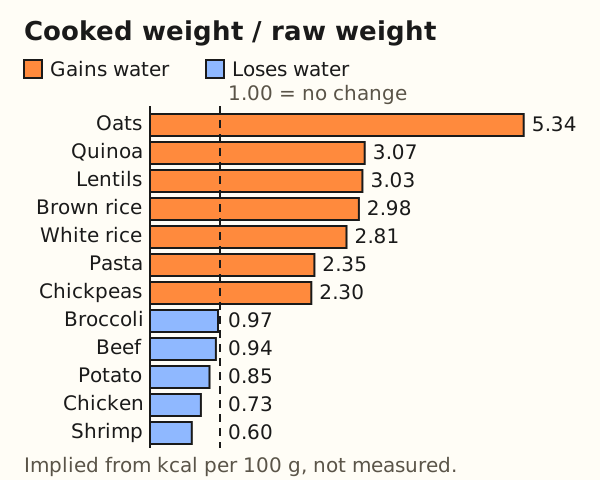
Food Standards Australia New Zealand (FSANZ) describes the same split: "The majority of changes result from the loss or gain of water. But for foods including meats and fried foods, there may also be a loss or gain of fat." That second sentence is why meat gets its own section below.
Raw and cooked calories for 15 common foods
All values are per 100 g from USDA FoodData Central, SR Legacy, a final release (April 2018) that USDA no longer updates. I read each energy and water value from the SR Legacy CSV download on 2026-10-16. The last column gives the FDC id pair, raw first.
| Food | Raw kcal | Cooked kcal | Weight ratio | FDC ids |
|---|---|---|---|---|
| White rice, long-grain, enriched (boiled) | 365 | 130 | 2.81 | 168877 / 168878 |
| Brown rice, long-grain (boiled) | 367 | 123 | 2.98 | 169703 / 169704 |
| Pasta, dry, enriched (boiled, no salt) | 371 | 158 | 2.35 | 169736 / 169737 |
| Oats, dry (cooked with water) | 379 | 71 | 5.34 | 173904 / 173905 |
| Quinoa (boiled) | 368 | 120 | 3.07 | 168874 / 168917 |
| Lentils (boiled, no salt) | 352 | 116 | 3.03 | 172420 / 172421 |
| Chickpeas (boiled, no salt) | 378 | 164 | 2.30 | 173756 / 173757 |
| Potato, russet, with skin (raw, baked) | 79 | 93 | 0.85 | 170027 / 170093 |
| Broccoli (raw, boiled, no salt) | 34 | 35 | 0.97 | 170379 / 169967 |
| Chicken breast, skinless (raw, roasted) | 120 | 165 | 0.73 | 171077 / 171477 |
| Salmon, Atlantic, farmed (raw, dry heat) | 208 | 206 | 1.01 | 175167 / 175168 |
| Ground beef, 80% lean (raw, broiled patty) | 254 | 270 | 0.94 | 174036 / 171797 |
| Shrimp, mixed species (raw, moist heat) | 71 | 119 | 0.60 | 174210 / 171971 |
| Bacon (raw, pan-fried) | 393 | 468 | 0.84 | 168277 / 168322 |
| Eggs, whole (raw, hard-boiled) | 143 | 155 | 0.92 | 171287 / 173424 |
Weight ratio is cooked weight divided by raw weight, calculated as raw kcal divided by cooked kcal. For white rice: 365 / 130 = 2.81.
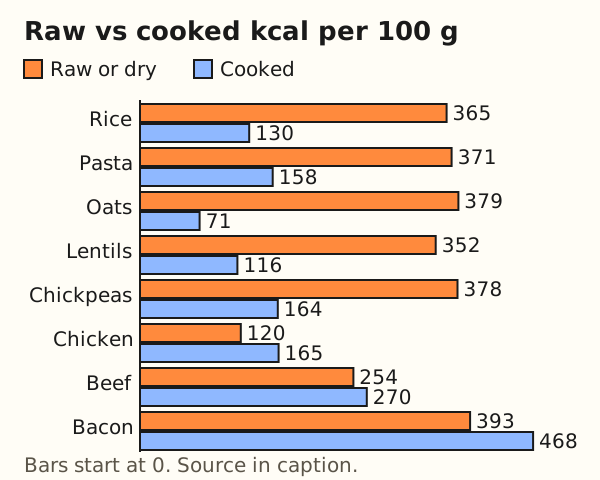
Each pair is two separate records, not one sample measured twice. Where the true change is small, the ratio can be noise. Salmon's raw and cooked records differ by 2 kcal per 100 g, which does not mean a fillet keeps its weight in the oven. FSANZ lists a 24 percent loss for baked or grilled fish fillets. The salmon calories page lists a raw fillet at 396 g and a cooked one at 356 g, as separate USDA records, not one fillet weighed twice.
The preparation is part of the record. Oats "cooked with water" are 83.61 g water per 100 g, so 5.34 belongs to thin porridge. The oats calories page lists dry and cooked rows, including 60 g of each. Chicken breast "cooked, fried" is 187 kcal per 100 g (FDC 171078) against 165 for roasted. Pick the record that matches how you cooked.
How reliable are implied weight ratios?
Test them against two other estimates. One is the dry matter ratio from water content, (100 - raw water) / (100 - cooked water). The other is an outside source: the FSANZ weight change factors, which it drew from "numerous local and overseas sources". A factor of +170 means cooked weight is 170 percent above raw, a ratio of 2.70.
| Food | Energy ratio | Water ratio | FSANZ ratio |
|---|---|---|---|
| White rice | 2.81 | 2.80 | 2.70 |
| Pasta | 2.35 | 2.38 | 2.31 |
| Quinoa | 3.07 | 3.05 | 3.00 |
| Lentils | 3.03 | 3.02 | 2.83 |
| Chickpeas | 2.30 | 2.32 | 2.83 |
| Chicken breast | 0.73 | 0.75 | 0.67 |
| Ground beef | 0.94 | 0.87 | 0.75 |
| Bacon | 0.84 | 0.70 | 0.60 |
| Salmon | 1.01 | 1.00 | 0.76 |
| Shrimp | 0.60 | 0.60 | 0.80 |
FSANZ ratio is 1 plus the factor divided by 100, for the closest listed food: rice grain +170, dried pasta boiled +131, "other grains" including quinoa +200, dried legumes boiled +183, chicken roasted -33, beef mince patty pan-fried or baked -25, bacon pan-fried -40, fish fillets baked or grilled -24, prawn poached -20. FSANZ groups lentils and chickpeas in one legume row and lists one poached prawn recipe, so those two comparisons are rough.
For rice, pasta and quinoa the three columns sit within 0.15 of each other. The meats split. For ground beef the energy ratio is 0.94, the FSANZ ratio is 0.75 and the USDA pan-broiled patty yield is 0.73. If the patty ends at 73 percent of its raw weight, 100 g of raw beef (254 kcal) becomes 73 g at 2.70 kcal per g: 73 x 2.70 = 197 kcal. About 22 percent of the energy is no longer in the patty. It went into the pan as rendered fat. For bacon the energy ratio is 0.84, the FSANZ pan-fried ratio is 0.60 and the USDA pan-fried yield is 0.32 (one sample). At 32 percent, 32 g x 4.68 = 150 kcal against 393 kcal raw, so about 62 percent of the energy is no longer in the strip. Raw bacon and cooked bacon are not the same piece of food in energy terms, so the energy ratio of 0.84 says little about how much of the strip is left. These combine a USDA energy value with a USDA or Australian yield, so read them as direction and size, not as a measured loss for your pan.
FSANZ states the limit itself: its factors "are indicative only, and are provided solely as a guide. It is better to calculate your own." The batch method below does that.
Why does cooked meat weigh less than raw?
Heat drives water out of muscle, and some fat melts and drips. Both leave the food, so the cooked piece weighs less and holds more protein and fat per gram.
The USDA Table of Cooking Yields for Meat and Poultry, Release 2 (Agricultural Research Service, September 2014, public domain) does not define cooking yield on its page, so I read the yield column as 100 times cooked weight divided by raw weight, and the table reports moisture change and fat change separately. I read its CSV file from Data.gov on 2026-10-16. It lists a yield of 72 percent for roasted chicken breast with skin (range 61 to 82 percent), 73 percent for pan-broiled medium-fat ground beef patties (range 70.78 to 75.97 percent, 4 samples) and 32 percent for pan-fried bacon (one sample). These rows describe specific cuts and methods. The chicken row is meat with skin from 1975 data, while the FoodData Central record used above is meat only.
I then compared the USDA yield with the three estimates above.
Worked example: 200 g of raw skinless chicken breast, roasted.
- Raw entry:
200 g x 120 kcal / 100 g = 240 kcal - Cooked weight by energy ratio:
200 x 120 / 165 = 145.5 g. By water ratio:200 x 26.1 / 34.74 = 150.3 g. By the FSANZ roasted factor:200 x 0.67 = 134 g. By the USDA yield for roasted chicken breast:200 x 0.72 = 144 g - Cooked entry on those weights:
145.5 x 1.65 = 240 kcal,150.3 x 1.65 = 248 kcal,134 x 1.65 = 221 kcal,144 x 1.65 = 238 kcal
The breast lands between 134 and 150 g cooked. Logging that weight against the cooked entry gives 221 to 248 kcal, between 8 percent under and 3 percent over the raw-entry figure of 240. USDA's own sample range of 61 to 82 percent is wider: 200 x 0.61 x 1.65 = 201 kcal to 200 x 0.82 x 1.65 = 271 kcal.
That spread is the size of the uncertainty when you cannot weigh the same piece before and after. Fat adds a second effect: a 2025 open-access study in Foods found that grilling, pan-frying and smoking cut the moisture of bluefish by 7 to 18 percent and raised total lipid content by 26 to 80 percent. The authors link the larger loss of omega-3 fatty acids in pan-fried fish partly to absorption of cooking oil.
Why do rice, pasta and beans get heavier?
Dry grains and beans take up water in the pot. In the USDA records 100 g of dry white rice ends at 280 g, so it absorbs about 180 g of water. The cooked weight is 2.8 times the raw weight for white rice, 2.98 for brown rice, 2.35 for pasta, 3.03 for lentils, 2.30 for chickpeas and 5.34 for oats cooked with water.
Each is one database record. Your pot will differ with the water, the cooking time and the heat. A cooked weight cannot be converted back to a dry weight without a guess of this kind. Canned and pouched legumes and grains are already cooked, so use the cooked entry. Per-food numbers are on the lentils, dry and boiled, chickpeas, dry and boiled and pasta, dry and cooked pages.
If you measure by volume, a cup of dry rice and a cup of cooked rice are different amounts of food. Cups versus grams covers that conversion.
How do you portion a pot of food by weight?
When you cook a pot to eat from over several meals, you need no ratio from a database. Your scale gives you your own.
- Weigh each raw ingredient as it goes in. Multiply each by its raw entry.
- Add up the energy of everything in the pot, including oil and sauce.
- Weigh the empty pot once. After cooking, weigh the pot with the food and subtract. That is the cooked weight.
- Divide the total energy by the cooked weight to get kcal per gram for this pot.
- Weigh your plate and multiply by kcal per gram.
Here is a pot of six portions, with the numbers a scale might show.
| Step | Reading | Calculation | Result |
|---|---|---|---|
| Dry rice | 330 g (FDC 168877, 365 kcal per 100 g) | 330 x 365 / 100 | 1,204.5 kcal |
| Olive oil | 13.5 g (FDC 171413, 884 kcal per 100 g) | 13.5 x 884 / 100 | 119.3 kcal |
| Whole pot | Rice plus oil | 1,204.5 + 119.3 | 1,323.8 kcal |
| Cooked weight | Pot with food 2,320 g, empty pot 1,420 g | 2,320 - 1,420 | 900 g |
| Energy density | Whole pot over cooked weight | 1,323.8 / 900 | 1.47 kcal per g |
| One portion | 150 g on the plate | 150 x 1,323.8 / 900 | 220.6 kcal |
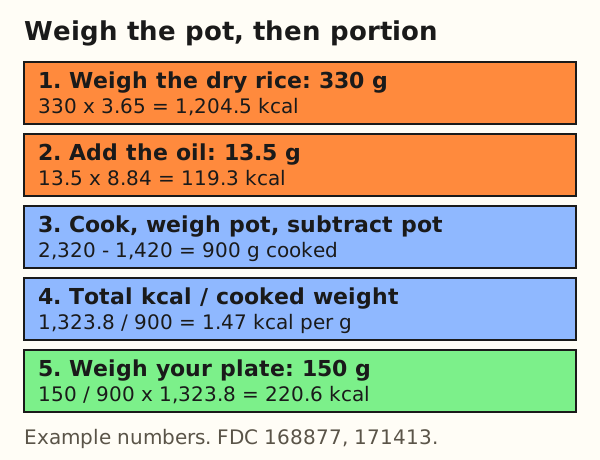
Compare a plain lookup. 150 g of cooked white rice is 150 x 130 / 100 = 195 kcal. The pot method on the rice alone gives 150 x 1,204.5 / 900 = 200.8 kcal. The 6 kcal difference is water: this pot ended at 900 / 330 = 2.73 times the raw weight, a little under the 2.81 the records imply, so each cooked gram holds slightly more rice. The oil adds 150 x 119.3 / 900 = 19.9 kcal to each portion.
The same steps work for a mixed pot. Add the raw weight and energy of the chicken, vegetables and sauce at steps 1 and 2. The mixed meal guide carries this through a full plate.
How do you count oil, butter and frying fat?
Count added fat as its own item. A plain "cooked" entry describes the food boiled, roasted or grilled. It does not include the oil you poured into the pan.
Olive oil is 884 kcal per 100 g in the USDA record (FDC 171413), and one tablespoon is 13.5 g.
Worked example: 150 g raw chicken breast fried in 1 tablespoon of olive oil.
- Chicken:
150 g x 120 kcal / 100 g = 180 kcal - Oil, if all of it is eaten:
13.5 g x 8.84 kcal per g = 119.3 kcal - Total:
180 + 119.3 = 299.3 kcal
Suppose 4 g of oil stays in the pan, only 9.5 g was eaten: 9.5 x 8.84 = 84 kcal, and the total is about 264 kcal.
How much oil stays in the food varies with the food, the heat and the time, and I found no open source that gives a number for home pan-frying. Log the full spoon for an upper bound, or weigh the oil in the pan before and after.
Do not count the fat twice. USDA has a record for chicken breast cooked, fried at 187 kcal per 100 g (FDC 171078), 22 higher than roasted at 165. Pick one route: the fried record, or a roasted record plus the oil you added.
Are nutrition facts on pasta for cooked or uncooked?
On a US package, the label describes the food as packaged. 21 CFR 101.9(b)(9) says the declaration of nutrient and food component content "shall be on the basis of food as packaged or purchased". Dry pasta in a box carries dry pasta values. A pouch of cooked rice carries cooked rice values. The rule has exceptions, such as raw fish and some foods packed in liquid.
Paragraph (e) lets a label add a second column. It allows nutrition information "for two or more forms of the same food", with values "for the form of the product as packaged and for any other form of the product". That is the "as prepared" column some mixes carry. A label for dry pasta or rice does not have to have one.
The serving size rules show the dry and cooked pair. For plain pasta the reference amount customarily consumed is 55 g dry or 140 g prepared. For plain grains such as rice it is 45 g dry or 140 g prepared (21 CFR 101.12, Table 2). With USDA values, 55 g x 3.71 = 204 kcal dry against 140 g x 1.58 = 221 kcal prepared. The two are close, not equal, because reference amounts are rounded regulatory figures, not yields.
To tell which state a label describes, read the serving size line. FDA's label page (content current as of 2024-03-05) says the amounts, calories included, refer to the size of one serving. Then divide calories by grams. Dry pasta is about 3.7 kcal per g and cooked pasta about 1.6, so 200 kcal for 56 g is 3.6 per g and describes dry pasta.
Other countries differ. In Australia and New Zealand, Standard 1.2.8 of the Food Standards Code says that if the label directs you to reconstitute a food with water, the panel "must express the information required by this Standard as a proportion of the reconstituted food" (clause 1.2.8-11), and that for a food to be drained before eating it must be given "as a proportion of the drained food" (clause 1.2.8-12). In the EU, the Food Safety Authority of Ireland says the nutrient values "must be for the food as sold", but "where appropriate, for example with a dried soup mix, the information may relate to the food after preparation, provided that sufficiently detailed preparation instructions are given". I did not check the UK or other countries. In every case, read the serving size line on your own package.
What should you tell your AI about raw or cooked?
Name the state in the sentence, with the grams. An AI picks a raw or cooked record when it estimates a meal, and a missing word makes it guess. These sentences leave nothing to guess:
- "150 g cooked white rice, boiled in water, no oil."
- "200 g raw chicken breast, skinless, weighed before cooking, pan-fried in 1 tbsp olive oil."
- "A pot with 250 g dry lentils, cooked in water, 6 equal portions. I ate one."
- "100 g canned chickpeas, drained."
You can also read a wrong state off an answer. Divide calories by grams and compare with the USDA density for that state. If the AI says 548 kcal for 150 g of cooked rice, that is 365 kcal per 100 g, the dry value. The cooked value is 130. When the density matches the other state, ask which one the AI used. This is check 1 from how to check an AI calorie estimate, applied to the state of the food.
What does picking the wrong state cost?
The gap for the same 150 g is 1.5 times the difference between the two per 100 g values. The share of a day uses a round 2,000 kcal as a yardstick, not a target.
| Food, 150 g | Raw kcal | Cooked kcal | Gap kcal | Of 2,000 |
|---|---|---|---|---|
| White rice | 547.5 | 195 | 352.5 | 17.6% |
| Pasta | 556.5 | 237 | 319.5 | 16.0% |
| Oats | 568.5 | 106.5 | 462 | 23.1% |
| Chicken breast | 180 | 247.5 | 67.5 | 3.4% |
| Ground beef, 80% lean | 381 | 405 | 24 | 1.2% |
White rice: 1.5 x 365 = 547.5 and 1.5 x 130 = 195, gap 547.5 - 195 = 352.5, share 352.5 / 2,000 = 17.6%. Other rows follow the same steps.
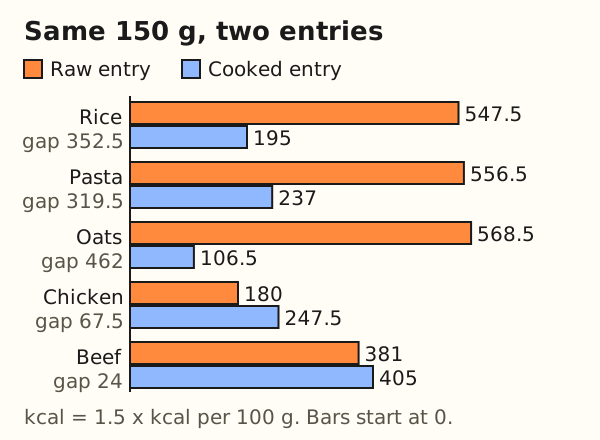
The more water a food takes up, the bigger the gap. Dry rice logged against the cooked entry undercounts by 352.5 kcal. Cooked rice logged against the dry entry overcounts by the same amount.
The error repeats. A 150 g portion of rice logged in the wrong state once a day for a week is 352.5 x 7 = 2,467.5 kcal off. How accurate is calorie counting puts that next to the other sources of error.
Where does Remembite fit?
Your AI does the math. Remembite keeps the record. Your AI turns "150 g cooked white rice, boiled, no oil" into a calorie and macro estimate. Remembite stores the meal and draws the charts.
Before it saves a meal, Remembite compares the number with a USDA-based reference for the foods it can confidently match. If the number is far off, it does not save it. It sends a question back to your AI, which asks you to confirm or fix it. Cooked rice logged at 548 kcal for 150 g is the sort of gap that can be flagged this way.
The check cannot know which state you put on the scale. It compares the number with the reference for the state your AI named. So the state still has to be in the sentence, and the weight has to be the one you measured.
What this post could not confirm
- USDA cooking yields apply to named cuts and methods, with wide sample ranges. Your cut and pan will differ.
- All kcal and water values come from SR Legacy, a final April 2018 release. Foundation Foods and branded products may differ.
- Weight ratios are implied by two separate records. FSANZ factors are indicative guides from domestic cooking. Neither replaces weighing your own pot.
- Label rules checked here are the US, Australia and New Zealand (Standard 1.2.8) and the EU as summarized by the Food Safety Authority of Ireland.
Remembite is not affiliated with USDA, FDA, Food Standards Australia New Zealand or the Food Safety Authority of Ireland.
Raw vs cooked calories: common questions
Do I weigh pasta before or after cooking?
Either, if the entry matches. Dry pasta weighed before the pot uses the dry entry (371 kcal per 100 g). Pasta weighed on the plate uses the cooked entry (158 kcal per 100 g). The box label describes the dry pasta.
How many grams of cooked rice come from 100 g of dry rice?
About 270 to 280 g. The USDA records imply 280 g and the Australian factor implies 270 g. Your pot may land elsewhere, so weigh one batch and keep the ratio.
I only weighed the meat after cooking. What now?
Use the cooked entry with the cooked weight. Do not convert back to raw. For chicken breast the weight ratio ranges from 0.67 to 0.75 across the four estimates, so a conversion adds more error than it removes.
Look up a food or keep a record
The calories section lists raw and cooked values per 100 g for common foods. To keep your own record, create an account and connect Remembite to your AI. Say raw or cooked in each sentence.
Estimates, not medical advice. How the numbers work.
Start your own record
Create a free account with your email, then add Remembite to Claude. Want to look first? Watch Claude log a sample day, no account needed.