AI Calorie Tracker: Photo App, Chat or MCP, Which Kind Fits
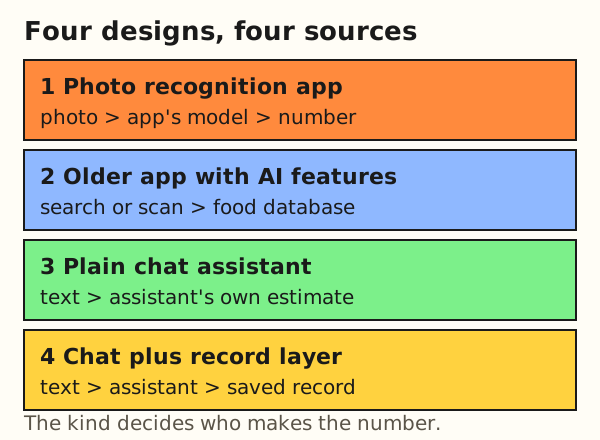
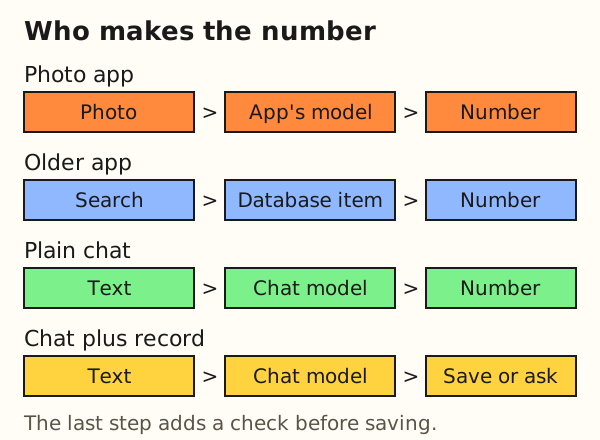
"AI calorie tracker" names four different designs: a photo recognition app, an older app with AI features, a plain chat assistant, and a chat assistant plus a record layer. The design decides who produces the number and whether anything saves it. No design removes the need to check portions. This guide describes each kind, dates every price, and does not rank products.
Remembite publishes this article and makes a product of the fourth kind, so we are not a neutral party. Facts about other products are as listed on their own pages, checked October 2026 (US), unless a row says otherwise. We did not test any of the apps.
Key takeaways
- There are four kinds: photo app, older app with AI features, plain chat, chat plus record. The kind tells you where the number comes from, which matters more than the "AI" label.
- Photo or meal-scan logging is listed as a paid feature on all three pages we read: Cal AI ("food scanning analysis results require a subscription"), MyFitnessPal (Premium) and Cronometer (Gold).
- The yearly list prices we could confirm are $59.99 (Cronometer Gold) and $79.99 (MyFitnessPal Premium, US App Store), a $20.00 gap. A general chat plan, Claude Pro, lists $200 billed yearly.
- A systematic review of 52 papers reports average overall relative errors for calories from 0.10% to 38.3% for AI against ground truth. No source we opened gives a figure for a named consumer app, so this page gives none.
- Rule for every kind: the portion you state or the app infers is the first thing to check, then the macro arithmetic.
- Remembite has no photo recognition and no barcode scanner. It is a record your AI writes to.
What are the four kinds of AI calorie tracker?
Table 1 sorts them by what you give the tool, where the number comes from, and whether a record is kept. The concept behind the sorting is explained in AI food logging explained.
| Kind | You give it | The number comes from | Record kept |
|---|---|---|---|
| Photo recognition app | A photo of the meal | The app's image model, which identifies items and estimates portions | In the app |
| Older app with AI features | A search, a barcode, sometimes a photo or a voice note | The app's food database; the AI step helps find the item | In the app |
| Plain chat assistant | A text description | The assistant's own estimate | Only the chat history |
| Chat assistant plus record layer | A text description to the assistant | The assistant's estimate, passed to a separate record tool | In the record tool |
What each kind is good at, and what to look at first:
- Photo recognition app. Fast at the table, because you only point a camera. A photo shows the surface of a meal, so oil, sauces and sugar inside it are guesses.
- Older app with AI features. The database does most of the work and the AI shortens the search. The entry you pick is only as good as the database behind it.
- Plain chat assistant. Flexible: you can describe a home-cooked dish in words. The estimate lives in a sentence, so totals and trends are yours to keep.
- Chat plus record layer. You keep chatting, and meals are saved with totals and charts. It depends on connecting the record tool to your assistant once.
Which products fall into each kind?
Table 2 names products only with what their own pages state. The wording in quotes is the page's, not ours. Inclusion is not an endorsement and the table is not a ranking.
| Product | Kind | What its page lists | Source |
|---|---|---|---|
| Cal AI | Photo app | "Snap a photo of your meal". The App Store listing adds "Food scanning analysis results require a subscription". The vendor site lists photo, barcode and description input. | App Store listing, calai.app |
| MyFitnessPal | Older app | Premium lists "Barcode Scan and Meal Scan" and Voice Log ("Log entire meals with your voice"). The App Store text mentions an "AI nutrition Coach". | Premium page, App Store listing |
| Cronometer | Older app | Gold lists Photo Log ("Take a photo of your meal and we'll identify the key ingredients and servings") and Voice Log. A free Basic plan logs foods, exercise, biometrics and notes. | Gold page |
| Claude | Plain chat | A general assistant. Its pricing page lists a Free plan with chat and memory across conversations, and no food database or log. ChatGPT is a plain chat of the same kind, but we could not open its pricing page. | Claude pricing |
| Nutrition MCP | Chat plus record | "a free, open-source Model Context Protocol (MCP) server". Generic foods use USDA FoodData Central values where available, otherwise "your AI estimates the rest". Photo and barcode input are listed. | nutrition-mcp.com |
| Ziva | Chat plus record | "Track nutrition through conversation". It "Works inside ChatGPT and Claude" and matches items to the USDA food database. | ziva.fit |
| Remembite (publisher) | Chat plus record | Your AI works out the numbers, Remembite saves meals and charts them. Works in Claude. No photo recognition, no barcode scanner. | Connect page |
Two things the table does not settle. First, features move between plans; a feature that is paid today may be free next year, and the reverse. Second, the line between kinds is soft. MyFitnessPal and Cronometer are database apps that now list photo and voice input, so they sit between kinds 1 and 2. What is useful is the question under the label: who makes the number, and where does it go next? Server-side detail on the record designs is in what a nutrition MCP server is.
What do AI calorie trackers cost?
Table 3 lists the free tier and the paid price each page states. A cell reads "not confirmed" where we could not read a price with its billing period. Prices are list prices for the region named and differ elsewhere: the MyFitnessPal Premium web page we opened showed Vietnamese dong (₫219,000 monthly, ₫1,119,000 yearly), while its US App Store listing shows dollars.
| Option | Free tier as listed | Paid price as listed | Region | Source |
|---|---|---|---|---|
| Cal AI | App is "Free" with in-app purchases; photo results need a subscription | Not confirmed. The listing shows purchase items from $0.99 to $29.99 with no billing periods | US | App Store |
| MyFitnessPal Premium | Free tier; Meal Scan and barcode scan are Premium | $19.99 monthly, $79.99 yearly (the listing also shows $9.99 and $49.99) | US | App Store |
| Cronometer Gold | Basic, $0; Photo Log is a Gold feature | $10.99 monthly, $59.99 yearly | Not stated | Gold page |
| Claude | Free, $0: chat, memory across conversations, connectors | Pro $20 monthly, or $17 a month billed $200 yearly | Not stated | Claude pricing |
| ChatGPT | Not confirmed | Not confirmed | Not stated | OpenAI's pricing page returned HTTP 403 to us |
| Nutrition MCP | "Nutrition MCP is free and ad-free." | None listed | Not stated | nutrition-mcp.com |
| Ziva | "Free to use" | None listed; its pricing page says "no paid tiers" | Not stated | ziva.fit |
| Remembite | Free to start | Any paid plan will be announced here before it begins. | Not stated | This site |
Three notes on reading the table. A chat assistant is a general subscription, so its price covers far more than calorie tracking. A photo app's "free" download may not include the photo feature. And a record layer on top of a chat assistant adds its own price, which is $0 or unconfirmed for the two we opened.
The billing period changes the total more than the brand does:
- MyFitnessPal Premium:
12 x $19.99 = $239.88monthly against$79.99yearly, so yearly costs79.99 / 239.88 = 33%of twelve monthly payments. - Cronometer Gold:
12 x $10.99 = $131.88monthly against$59.99yearly, which is59.99 / 131.88 = 45%. - Claude Pro:
12 x $20 = $240monthly against$200yearly, which is200 / 240 = 83%. The page's "$17 a month" is200 / 12 = $16.67, rounded. - Gap between the two tracker apps' yearly prices:
79.99 - 59.99 = $20.00.
We draw no price chart, because only two tracker prices could be confirmed with a billing period. Cal AI and ChatGPT are blank for that reason.
How close are AI calorie estimates?
Nobody can give one number for all of them. Estimates from photos and text can be close for simple foods and far off for mixed dishes, and the studies behind that sentence are summarised in AI food logging explained and how to check an AI calorie estimate. We do not repeat their numbers here. Two reviews add the wider picture.
What do the two reviews say?
Shonkoff and colleagues (Annals of Medicine, December 2023) reviewed AI-based image dietary assessment against ground truth and against humans. Their abstract reports "average overall relative errors (AI vs. ground truth) ranged from 0.10% to 38.3% for calories" and 0.09% to 33% for volume. They note that variability in food image databases and in the results reported prevented a meta-analysis. Their key messages say the available tools "need more development before deployment as stand-alone dietary assessment methods".
Chotwanvirat and colleagues (Journal of Medical Internet Research, 2024) scoped 84 included articles out of 522 found. They write that most systems were validated for macronutrient and energy estimation, and only a few for micronutrients such as sodium. Their discussion names the hard parts: estimating volume from one image, converting volume to weight, which "relies on food-specific density values", and the fact that additional components such as seasonings and cooking oil "must be estimated".
What these reviews do not tell you: how any app on your phone performs on your meals. They cover research systems, not products, and neither review names an app we list above. We cite no vendor claims about how close their numbers are.
Where do the errors enter?
- The portion. A photo or a sentence like "a bowl of rice" fixes the amount only roughly. A weighed 150 g fixes it.
- Hidden ingredients. Oil, butter, sauce and sugar are cheap in grams and costly in kcal. The Chotwanvirat review lists them as something that must be estimated.
- The reference value. A database entry, an AI's memory and a lab value can differ for the same food. Raw and cooked weights differ too.
- The arithmetic. Protein, carbs and fat should roughly add up to the stated calories. This is the only one of the four that a program can check without a photo.
How can you test one yourself?
Pick five meals you eat every week. Weigh each on a kitchen scale once and write down the grams. Log the same meals in the tool you are considering, giving it the grams where it accepts them. Then compare its calories and protein with the package label, or with a value you look up in FoodData Central. Repeat for a week. A tool that is off by a similar amount in the same direction every time is easy to live with, because you can adjust for it. A tool that swings both ways is harder to trust. The test costs nothing on a free tier and tells you more than any page, including this one.
How do you choose between them?
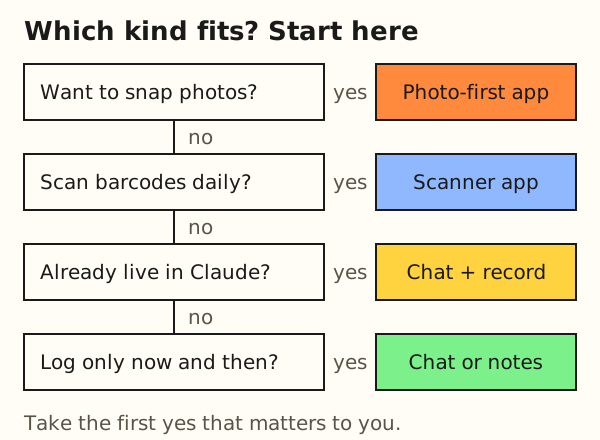
Take the first yes that matters to you. These are kinds of tool, not rankings.
| If you | Consider | Trade-off |
|---|---|---|
| want to snap a photo | A photo-first app, or the photo feature inside a tracker | Photo logging is listed as paid by Cal AI, MyFitnessPal and Cronometer. Remembite has no photo recognition. |
| scan packaged food every day | An app with a barcode scanner | Cronometer's page lists the scanner in both plans; MyFitnessPal lists it in Premium. Remembite has no barcode scanner. |
| want to log by voice | A tracker with voice logging | MyFitnessPal lists Voice Log in Premium and Cronometer lists it in Gold. |
| already use Claude every day | A chat plus record design, such as Nutrition MCP, Ziva or Remembite | You connect it once. Remembite works in Claude and, in beta, in ChatGPT (via developer mode). |
| log a few times a month | A plain chat, or a notes file | No saved totals. You add them up yourself. |
If none of these fits, start with the free tier of whichever you already have open. For a longer price-and-feature comparison of database apps, see MyFitnessPal alternatives compared.
What does one dinner look like in each kind?
The dinner is hypothetical: grilled chicken, cooked rice and a spoon of olive oil. This is how the records differ, with no error figure implied.
- Photo app. You photograph the plate. The app returns one estimate for the plate and stores it. Afterwards you can open the entry and edit items, but the portion came from the image and the oil is a guess.
- Plain chat. You type "150 g cooked rice, 120 g chicken, 1 tablespoon oil". The assistant answers in a sentence. The answer sits in the chat. To get a day total, you scroll back and add.
- Chat plus record. You type the same sentence. The assistant sends each item with grams, kcal, protein, carbs and fat. The record tool checks them and saves, or sends a question back. The day total builds itself.
The check in the third design is plain arithmetic. This one uses invented numbers.
Worked example: hypothetical item values, to show the macro check.
- The assistant sends: 600 kcal, 40 g protein, 50 g carbs, 20 g fat.
- Macros in kcal:
40 g x 4 + 50 g x 4 + 20 g x 9 = 160 + 200 + 180 = 540 kcal - Gap:
600 - 540 = 60 kcal, which is60 / 600 = 10%.
Here the macros add up to less than the stated 600 kcal, so this check passes and, if the food also matches its reference, Remembite saves the meal. Remembite allows a margin of 20% plus 50 kcal, which is 600 x 1.2 + 50 = 770 kcal. If the macros had added up to 800 kcal, clearly more calories than the item's own 600, Remembite would save nothing and send a question back for you to answer. The 4, 4 and 9 factors are the general ones explained in our checking guide.
A photo app can run a similar check inside its own code. Its pages do not say, so we make no claim either way.
Where does Remembite fit?
Your AI does the math. Remembite keeps the record. It belongs to the fourth kind. You describe a meal to Claude, Claude works out grams, calories, protein, carbs and fat, and Remembite saves the meal, charts the day and remembers foods you name.
Before saving, Remembite checks each food it can confidently match to a USDA-based reference. If the calories are far from that reference, or the protein, carbs and fat add up to clearly more calories than the item, it saves nothing and sends a question back to your AI, which asks you. A food it cannot match is saved as your AI sent it, with only the macro check. The USDA data comes from FoodData Central, which USDA describes as its "comprehensive source of food composition data".
To connect: in Claude choose Customize, Connectors, Add, then Add custom connector, and enter https://remembite.com/mcp. On Team and Enterprise plans an organization Owner adds it first. For ChatGPT (beta), see the ChatGPT steps. Other steps are on the connect page, and a walkthrough is in how to log meals with Claude. The Account page exports your data as JSON or CSV and can delete the account.
What it lacks: no photo recognition, no barcode scanner and no Apple Health sync. Remembite is free to start. Any paid plan will be announced here before it begins.
Frequently asked questions
What is an AI calorie tracker?
It is a tool that uses AI to turn a meal into calories and macros. It comes in four kinds: photo apps, older apps with AI features, plain chat assistants, and chat assistants with a record layer. The kind decides where the number comes from.
How close are AI calorie estimates to the real value?
It depends on the food, the portion and the method. A 2023 review reports average overall relative errors for calories from 0.10% to 38.3%. See how to check an AI calorie estimate.
Is there a free AI calorie tracker?
Some options list a free tier: Cronometer Basic (Photo Log is Gold), Nutrition MCP ("free and ad-free") and Ziva ("Free to use"). Cal AI's listing says photo results need a subscription, and Remembite is free to start. Checked October 2026 (US).
Do AI calorie counting apps work?
They work as a fast estimate, and the reviews above show wide error ranges. Weigh portions when it matters, and check the oil and sauces that a photo or a sentence leaves out.
Can ChatGPT or Claude be my calorie tracker?
For occasional estimates, yes. A chat alone does not keep a log with totals. The evidence and the limits are in can ChatGPT or Claude track calories.
What is the difference between a photo app and a chat assistant?
A photo app estimates from an image and stores the entry. A chat assistant estimates from your words, which can include grams, and stores nothing unless a record tool is connected.
What can this guide not tell you?
- Which product is best or most precise. We did not test any app, and no source we opened compares them head to head.
- Current prices. Prices and features were read in October 2026 and change. Check the linked page before you pay.
- Prices outside the regions named, and any price in a blank cell.
- How a photo app checks its own numbers. Their pages do not say.
Remembite publishes this article and makes a product in this area. Remembite is not affiliated with Cal AI, MyFitnessPal, Cronometer, Nutrition MCP, Ziva, Anthropic or OpenAI.
Estimates, not medical advice. How the numbers work.
Start your own record
Create a free account with your email, then add Remembite to Claude. Want to look first? Watch Claude log a sample day, no account needed.