How to Track Macros With Claude: A Simple Weekly Routine
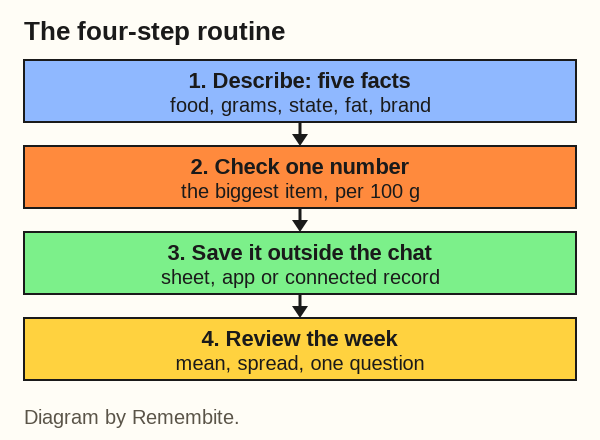
Yes, Claude can work out protein, carbs and fat (macros) for a meal you describe. In our reading, the numbers are easier to compare from one day to the next when you give Claude the same five facts every time and keep the result somewhere other than the chat. The routine has four steps: describe the meal with five facts, check one number, save it, review the week.
Key takeaways
- Five facts per meal: food, amount in grams, raw or cooked, how it was cooked or what fat was added, and brand or restaurant.
- Check one number per meal, the biggest item, against a USDA value per 100 g. Do not re-check every line.
- A chat is not a database. Anthropic describes Claude's memory as a set of individual topics, not a per-meal log, so totals need a record outside the chat.
- Once a week, add up seven days of protein grams, divide by 7 for the mean, and look at the gap between your highest and lowest day.
- Custom connectors are available on Free, Pro, Max, Team and Enterprise plans per Anthropic's page, with one connector on Free (checked October 2026).
What should you tell Claude about every meal?
Five facts. Each one removes a guess that Claude would otherwise make for you, and a guess can land differently the next time you ask. Table 1 lists them with a made-up example (hypothetical).
| Fact | Example | Why it matters |
|---|---|---|
| 1. Food | Chicken breast, no skin | A vague name such as "chicken" can match several different entries. |
| 2. Amount in grams | 170 g | Grams give Claude a firm number. "A big piece" does not. |
| 3. Raw or cooked | Cooked weight | Water leaves in the pan, so 100 g raw and 100 g cooked are different amounts of food. |
| 4. Cooking and added fat | Pan-fried in 1 tbsp olive oil | Oil adds fat and calories that the food alone does not show. |
| 5. Brand or restaurant | The name on the pack, or the place you ate | A packaged product has its own label, and a restaurant dish has its own recipe. |
The weighing detail lives in how to weigh food for calorie counting. The raw and cooked rule, with the reason water changes the number, is in raw vs cooked calories. The USDA Agricultural Research Service describes its cooking yields table as "measures of changes in meat and poultry weights resulting from moisture and fat losses during cooking" (USDA ARS, cooking yields). That is why fact 3 is on the list.
Packaged food adds one more habit. The FDA states that "all the nutrient amounts shown on the label, including the number of calories, refer to the size of the serving" (FDA, how to use the Nutrition Facts label). Tell Claude the serving size on the label next to the grams you ate, so it does not mix the two.
What messages work for each kind of meal?
Short and copyable. Table 2 gives one message per situation and what a good reply contains. All meals and numbers here are hypothetical.
| Situation | Message to send | Good reply |
|---|---|---|
| Home meal | 170 g chicken breast, cooked weight, pan-fried in 1 tbsp olive oil, plus 200 g cooked white rice. Give one line per item with grams, kcal, protein, carbs and fat. | One line per item, the oil on its own line, and a total. |
| Photo or text | [photo] Lunch. My scale says chicken 150 g and rice 180 g, both cooked. About 1 tbsp of oil. Ask me about anything you cannot see. | Items read from the photo, your grams used instead of its guess, and a question about sauce or oil. |
| Restaurant meal | Grilled salmon with potatoes and salad at a casual restaurant. I do not know the weights. Estimate, tell me your assumptions, and ask one question if sauce or oil matters. | A range or a single estimate, the portion and oil it assumed, and at most one question. |
| Batch recipe | Chili, 6 servings: 900 g raw ground beef, 800 g drained beans, 400 g tomatoes, 2 tbsp oil. Finished pot weighs 2,100 g. I ate 350 g. | Totals for the pot, then my share as 350 / 2,100 of it. |
| Repeat | Log yesterday's lunch again with 100 g rice instead of 180 g. | The same items, one changed, the rest untouched. |
| Correction | Correction: the chicken was 130 g, not 170 g. Replace that line and give me the new meal total. | The new line, the new total, and the old value named. |
Two notes. A photo shows the food but not how much oil went into the pan, so say it in words. And a repeat only works if Claude can see the earlier meal: in a plain chat that means the same thread, with a connected record it means a search of what is saved. For the pot method behind the chili row, see the batch section of the weighing guide linked above.
How do you tell when a macro number looks wrong?
Pick the biggest item in the meal and compare it with a USDA value per 100 g. If the two are far apart, ask Claude which entry it used and whether it was raw or cooked. The steps, including how to test that protein, carbs and fat fit the calories, are in how to check an AI calorie estimate, so this page does not repeat them.
Why do macro numbers change between chats?
Because each chat produces a new estimate, and a chat is not a log. Anthropic's help page on memory says that "Claude saves memory as a set of individual topics as you chat, rather than summarizing conversations after they end" (Claude help: chat search and memory, checked October 2026). The same page says memory is on by default for Free, Pro and Max plans, that each project has its own memory, and that "Searching past chats is available to users on paid plans".
It also says that "By default, Claude does not store topics related to personal or sensitive subject matter", with health as one of the examples. Whether a food diary counts as health is Claude's call, and we have not tested it. None of this describes a table of meals with one current value per item. That last point is our reading of the page, not a statement from Anthropic.
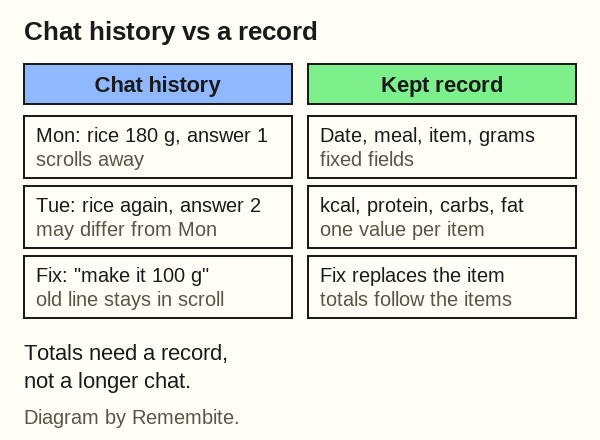
The studies on how much an AI estimate scatters when you ask twice are in can ChatGPT or Claude track calories. We do not restate them here. The practical rule: ask once, save the answer, and do not shop for a different number by asking again.
Where should the numbers live?
Somewhere that holds one current value per item. Table 3 compares four places.
| Place | Good for | Weak spot |
|---|---|---|
| The chat | A quick estimate for one meal | Totals live inside one thread; no per-meal log |
| A spreadsheet | Full control of every column and formula | You paste or type each row yourself |
| A logging app | Daily totals and charts without extra work | You usually enter meals in the app's own way |
| A connector with a record | Saying the meal in chat and having it saved | The estimate is still an estimate, and a guessed portion can pass the check |
The spreadsheet route is covered in macro tracking without an app, which compares three methods.
Remembite is the fourth row. Claude estimates each meal and sends the values; Remembite saves the meal with the values Claude sent. When a food is one it can confidently match to a USDA-based reference and the numbers are far from it, Remembite does not save the meal and Claude asks you first. It does the same when an item's protein, carbs and fat add up to more calories than the item. Later you can ask Claude about a meal you logged before, in a new chat, and it can look it up in the record. Remembite works in Claude on web and desktop, and in ChatGPT (beta, via developer mode). The setup is on the connect page, and log meals with Claude walks through a week of use.
What does a weekly macro review look like?
Seven numbers, one mean, one spread and one question. This example uses protein and made-up grams, with no target. The weekly average guide explains why a week says more than a single day.
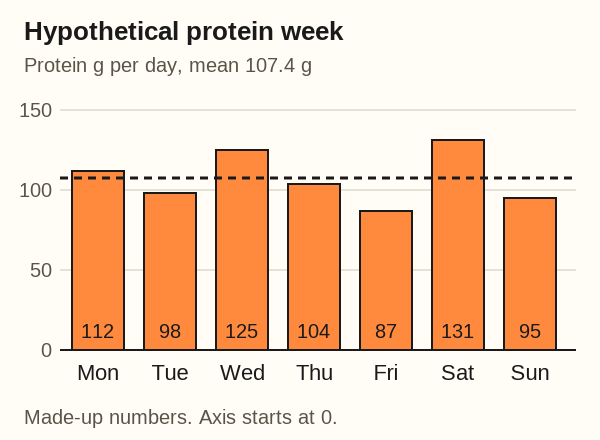
Worked example: seven days of protein in grams (hypothetical): 112, 98, 125, 104, 87, 131, 95.
- Sum:
112 + 98 + 125 + 104 + 87 + 131 + 95 = 752 g - Weekly mean:
752 / 7 = 107.4 g - Spread between the highest and lowest day:
131 - 87 = 44 g - Distance of the two outer days from the mean:
87 - 107.4 = -20.4 gand131 - 107.4 = 23.6 g
Then ask Claude one question: "Here are my seven days. Which two days are furthest from the mean, and what did I eat on them?" The answer points to meals to look at, such as a skipped lunch or a large restaurant dinner. It does not say whether 107.4 g is the right amount for you.
With a connected record you do not paste the seven numbers: you ask Claude to read the week from the record. Either way, check the arithmetic once by hand the first time. Claude can add seven numbers, but a typo in your paste would carry into the mean.
Does Claude have a built-in macro tracker?
We found none. Claude's pricing page, checked October 2026, lists "Memory across conversations" and "Connect your apps and tools" for the Free plan, along with web search, file creation and code execution (Claude pricing). We found no nutrition or macro tracking feature on that page or on the two help pages we opened for this article. We could not search every Anthropic page, so treat this as "not found", not "does not exist".
What can Claude not do for macro tracking?
Three things, none of them a fault of the model. It does not keep an exact log of your meals unless a record is connected, because memory is made of topics. It does not promise the same answer to the same question twice, because each answer is a new estimate. And it cannot see what you did not say: the oil, the sauce, the weight on the plate. The five facts in Table 1 exist for the third gap. Weighing food closes it better than any check, as the weighing guide above explains.
What are the limits of this routine?
- These are estimates. A portion guessed wrong can still look consistent with the food.
- The examples are hypothetical. They are not a real log and not a target.
- Plan rules for custom connectors come from Anthropic's page, checked October 2026, and can change. Read it before you rely on it (see the FAQ).
- USDA data sets differ by purpose. FoodData Central describes SR Legacy as "historic data on food components" with a final release in April 2018, and Foundation Foods as data on minimally processed foods (FoodData Central documentation). A food can have more than one entry, so name raw or cooked.
- This is not medical or dietary advice.
FAQ
Can Claude track macros?
It can work out protein, carbs and fat for a meal you describe. Tracking over days needs a place to keep them, such as a spreadsheet or a connected record, because a chat does not keep a per-meal log.
Does Claude remember what I ate yesterday?
Not as a log. Anthropic describes memory as a set of individual topics, and searching past chats is for paid plans. With a record connected, you can ask about a meal you logged before and Claude can look it up there.
How do I log a recipe I cooked in a batch?
Give Claude the raw ingredients in grams, the finished pot weight and the weight you ate. The share you ate is your weight divided by the pot weight, for example 350 / 2,100 in Table 2.
How do I log a restaurant meal?
Describe the dish, say you do not know the weights, and ask Claude to state its assumptions and ask one question about sauce or oil. Treat the result as a wider estimate than a weighed home meal.
Do I need a paid Claude plan to connect Remembite?
Anthropic's page says custom connectors are available on Free, Pro, Max, Team and Enterprise plans, and that "Free users are limited to one custom connector". On Team and Enterprise, an Owner must add the connector first. The path in Claude is Customize > Connectors > + Add > Add custom connector (Claude help: custom connectors, checked October 2026). Remembite is free to start, and any paid plan will be announced on remembite.com before it begins.
Your AI does the math. Remembite keeps the record.
Estimates, not medical advice. How the numbers work.
Start your own record
Create a free account with your email, then add Remembite to Claude. Want to look first? Watch Claude log a sample day, no account needed.