How to Weigh Food for Calorie Counting
Put an empty bowl on the scale and press tare so it reads 0 g. Add one food and note the grams. Press tare again, add the next food, and repeat. The one choice that matters is the state: weigh each food in the same state as the database entry you log it against, usually raw for meat and dry for rice, pasta and oats. Everything below covers the awkward cases: oil, soup, packages and the arithmetic of a mistake.
Key takeaways
- Four actions cover a whole plate: tare, add one food, read the grams, tare again. One bowl, one reading per food.
- The state on the scale must match the entry. USDA lists 150 g of dry white rice at 548 kcal and 150 g of cooked white rice at 195 kcal (FDC 168877 and 168878).
- Fat carries the most error per gram. One gram of olive oil is 8.84 kcal, so a 20 g slip is 177 kcal. The same slip on cooked rice is 26 kcal.
- For a pot, weigh it empty, weigh it full, subtract, and divide the total kcal of the ingredients by the grams of food.
- USDA puts one tablespoon of olive oil at 13.5 g. A scale reads the oil itself, so you do not need to decide how full the spoon was.
- Research on portion estimates and self-reported intake shows large gaps between what people think they ate and what they ate. A scale replaces a guess with a reading. It does not correct a wrong database entry.
What do you need to weigh food?
A digital kitchen scale and a bowl. Almost any model works for plates and bowls. Four features decide whether it suits calorie counting.
| Feature | Why it matters | What to look for |
|---|---|---|
| Resolution | One gram of olive oil is 8.84 kcal. A scale that moves in 5 g steps can be off by 2.5 g from rounding alone, which is 22 kcal of oil. | A display that moves in 1 g steps or finer |
| Capacity | The scale carries the bowl and the food. The hypothetical stew below reads 3,350 g in its pot. | A maximum printed on the scale above your heaviest pot plus its food |
| Tare button | It zeroes the bowl, then each food you add, so you never subtract in your head. | A tare key that resets the display to 0 g in one press |
| Unit switch | Recipes and labels use grams or ounces. Databases here use grams. | A button that switches between g and oz |
| Flat platform | A tilted or soft surface moves the reading. A bowl that covers the display gets read wrongly. | A hard, flat counter and a display you can see around the bowl |
If your scale shows ounces, convert with 1 oz = 28.3495 g. The National Institute of Standards and Technology (NIST) lists the avoirdupois ounce at 2.834 952 E+01 grams. These are weight ounces. The fluid ounces printed on a measuring jug are a volume and do not convert this way.
| Ounces (oz) | Grams (g) |
|---|---|
| 0.5 | 14.2 |
| 1 | 28.3 |
| 2 | 56.7 |
| 4 | 113.4 |
| 8 | 226.8 |
| 16 | 453.6 |
Database values here are per 100 g, so work in grams when you can. The USDA records used on this page are from FoodData Central, SR Legacy, a dataset whose last release was April 2018.
What is the four-step method for weighing food?
Use one bowl or plate for the whole meal and weigh each food straight into it.
- Place the empty bowl on the scale and press tare. The display reads 0 g.
- Add one food. Read the grams and write them down or say them to your AI app.
- Press tare again. The display returns to 0 g with the first food still in the bowl.
- Add the next food, read it, and tare again. Repeat until the plate is built.
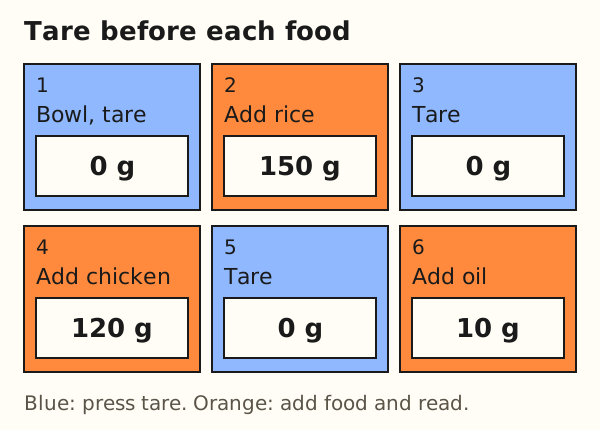
Worked example: A hypothetical plate of cooked white rice, roasted chicken breast and olive oil, weighed in one bowl.
- Tare the bowl. Add rice until the scale reads 150 g. Rice:
150 g x 130 kcal / 100 g = 195.0 kcal(FDC 168878, cooked). - Tare. Add chicken until the scale reads 120 g. Chicken:
120 g x 165 kcal / 100 g = 198.0 kcal(FDC 171477, roasted). - Tare. Pour oil until the scale reads 10 g. Oil:
10 g x 884 kcal / 100 g = 88.4 kcal(FDC 171413). - Add the lines:
195.0 + 198.0 + 88.4 = 481.4 kcal
The 10 g of oil is 18 percent of the plate's kcal and about 4 percent of its weight. This is why the oil gets its own reading.
Weigh what you will eat. Skins, bones, shells and cores that you leave on the plate do not belong in the reading, so weigh them off or pick the entry that says "bone and skin removed". USDA's roasted chicken breast record (FDC 171477) is meat only, with bone and skin removed.
Should you weigh food raw or cooked?
Weigh it in the state of the entry you log it against, and say which state you used. Raw chicken on the scale pairs with a raw chicken entry. A cooked portion on the plate pairs with a cooked entry. Mixing the two moves the result by a lot: 150 g x 365 kcal / 100 g = 547.5 kcal as dry white rice (FDC 168877) and 150 g x 130 kcal / 100 g = 195.0 kcal as cooked (FDC 168878).
Raw or dry weights hold steady, because the water a pot adds or removes is not in the number. Cooked weights suit food you only handle once it is done, such as leftovers or takeout. The concept, the water arithmetic and a table of 15 foods sit in weigh food raw or cooked. This page stays with the method.
How do you weigh liquids, oils and sauces?
Put the bowl or glass on the scale, tare, and pour. Grams work for liquids too, so no jug is needed. For oil, nut butter, syrup and sauces, a reading in grams is the only number that does not depend on how full the spoon looked.
Spoons carry two problems. A spoon is a volume, and the grams in it depend on the food. A heap, a level scoop and a drip all fill the same spoon with different amounts. USDA portion rows show the first problem. They give grams per household measure for one food, as measured by USDA, with no word on how full the measure was.
| Food | FDC id | USDA portion row | Grams (g) | kcal |
|---|---|---|---|---|
| Olive oil | 171413 | 1 tablespoon | 13.5 | 119.3 |
| Olive oil | 171413 | 1 teaspoon | 4.5 | 39.8 |
| Peanut butter, smooth | 174266 | 2 tablespoons | 32 | 191.4 |
| Almonds | 170567 | 1 oz (23 whole kernels) | 28.35 | 164.1 |
| Almonds | 170567 | 1 cup, whole | 143 | 828.0 |
| Cheddar cheese | 173414 | 1 cup, shredded | 113 | 455.4 |
| Cheddar cheese | 173414 | 1 cup, diced | 132 | 532.0 |
The last two rows show the same cup holding 113 g or 132 g, depending on how the cheese was cut. The kcal column is the portion's grams times the record's kcal per 100 g, divided by 100. For the cheddar cup, 132 g x 403 kcal / 100 g = 532.0 kcal.
US food labels use a fixed volume. FDA guidance for the metric equivalents of household measures says "1 tablespoon means 15 mL". USDA's olive oil row is 13.5 g for a tablespoon, which is 13.5 g / 15 mL = 0.9 g per mL. A tablespoon of peanut butter is a different mass again, 16 g in the USDA row above (32 g / 2 = 16 g).
Worked example: A hypothetical scoop of peanut butter that ends up heavier than the USDA tablespoon.
- USDA tablespoon:
16 g x 598 kcal / 100 g = 95.7 kcal - A scoop that weighs 24 g on the scale:
24 g x 598 kcal / 100 g = 143.5 kcal - Difference:
143.5 - 95.7 = 47.8 kcal
The 24 g is invented to show the gap. The scale shows the real gram figure. The spoon only shows that you used "one spoon". Cups, ml and level spoons for other foods are covered in cups to grams for calorie counting.
For oil in a pan, pour it into a cup on the scale first and log what you poured. Some stays in the pan, so this can overcount slightly.
How do you weigh a pot of soup or meal prep?
Weigh the empty pot, weigh the full pot, subtract, and divide. Then weigh your portion and take its share. You need the kcal total of everything that went in, and nothing needs to be guessed about the finished pot.
- Weigh the empty pot with its lid and spoon, if they stay on it. Write the number down.
- Weigh each ingredient as you add it, using the tare method above. Raw ingredients on the scale pair with raw entries.
- When the pot is done, weigh it full. Subtract the empty pot.
- Divide the total kcal by the grams of food in the pot. That is kcal per gram.
- Weigh your bowl of it and multiply by kcal per gram.
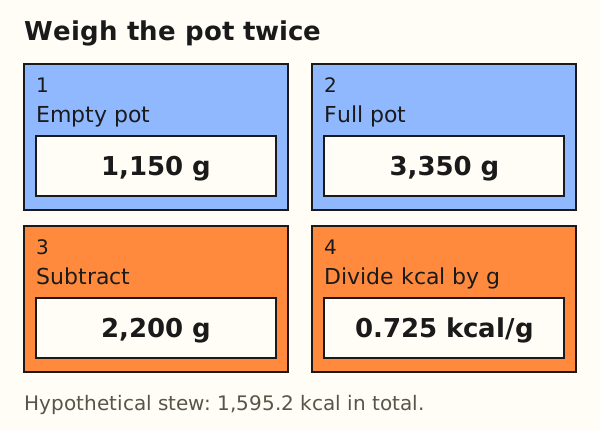
Worked example: A hypothetical stew of raw chicken breast, dry white rice, olive oil and water.
- Chicken, raw:
500 g x 120 kcal / 100 g = 600.0 kcal(FDC 171077) - Rice, dry:
200 g x 365 kcal / 100 g = 730.0 kcal(FDC 168877) - Olive oil:
30 g x 884 kcal / 100 g = 265.2 kcal(FDC 171413) - Total in the pot:
600.0 + 730.0 + 265.2 = 1,595.2 kcal - Food in the pot:
3,350 g - 1,150 g = 2,200 g - Your bowl weighs 350 g:
1,595.2 kcal x 350 / 2,200 = 253.8 kcal
Water adds weight and no kcal, so more water makes each bowl heavier and lighter in kcal per gram. Weigh the finished pot every time, since the evaporation changes between cooks.
The kcal total is the part a scale cannot reach. If the recipe has sauces, cheese or hidden fat, the ingredient list is the place to be careful. That topic has its own page, calories in a mixed meal.
How do you weigh packaged food?
Use the gram weight printed on the label. The US Food and Drug Administration (FDA) describes the label serving size as "a common household measure that is appropriate to the food" and "followed by the metric amount in grams (g)". The grams are the part to use.
Weigh what you eat and scale the label. If the label shows a per-100 g column, multiply by your grams and divide by 100. If it shows only a serving, divide your grams by the serving grams and multiply by the serving's kcal.
Worked example: A hypothetical bar with a label serving of 55 g and 220 kcal. You weigh 82 g.
- Share of the serving:
82 g / 55 g = 1.49 - Calories:
82 g x 220 kcal / 55 g = 328.0 kcal
The label figure is rounded by the manufacturer, so 328 kcal is a close reading and not an exact one.
The FDA metric guidance says grams and milliliters are generally rounded to whole numbers, so a small mismatch is normal. Dry foods raise the state question again, and the post are nutrition facts cooked or uncooked covers what a label describes.
How much does a weighing error matter?
It depends on the food. The kcal effect of a mis-weigh is the grams missed times the food's kcal per gram. Fat-rich foods turn a small slip into a large one. Water-rich and starchy foods forgive it.
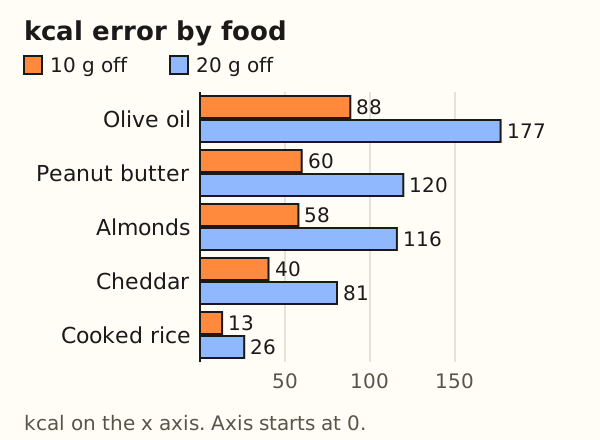
| Food | kcal per 100 g | 10g kcal | 20g kcal | FDC id |
|---|---|---|---|---|
| Olive oil | 884 | 88.4 | 176.8 | 171413 |
| Peanut butter, smooth | 598 | 59.8 | 119.6 | 174266 |
| Almonds | 579 | 57.9 | 115.8 | 170567 |
| Cheddar cheese | 403 | 40.3 | 80.6 | 173414 |
| White rice, cooked | 130 | 13.0 | 26.0 | 168878 |
Each cell is the record's kcal per 100 g times the error in grams, divided by 100. For olive oil at 20 g, 884 x 20 / 100 = 176.8. This is Remembite arithmetic on USDA values. It says nothing about how large real kitchen errors are. It only shows where an error of any size costs most.
Published research on how people judge amounts shows why a reading is worth taking. Almiron-Roig and colleagues had 32 adults estimate the number of portions in 33 foods and drinks. Their abstract reports that "participants tended to underestimate the number of portions displayed" and that high energy density foods were overestimated, while beverages and medium energy density foods were underestimated by 30 to 46 percent. The sample was small and lab-based, and it tested counting portions, not weighing.
A 1992 New England Journal of Medicine study by Lichtman and colleagues looked at self-reported intake. Ten adults with obesity who reported eating under 1,200 kcal a day had their actual intake evaluated over 14 days by indirect calorimetry and body composition analysis. The group "underreported their actual food intake by an average (+/- SD) of 47 +/- 16 percent". That study is old, small and specific to one group. It supports a narrow point: reported intake can sit far from evaluated intake. It does not say how far off a kitchen scale can be.
What do you tell your AI app about the grams?
Give grams and state for each food, one line each. The plate above becomes: "150 g cooked white rice, 120 g roasted chicken breast, meat only, 10 g olive oil." With grams and a state, the AI app has no portion to guess. For how an estimate drifts and how to check it, see how to check AI calorie estimates.
When can you skip the scale?
Whenever the effort costs more than the accuracy is worth to you. An estimate still gives a useful record. Some days you eat out or share a plate. Logging those meals as estimates is better than a gap, and the log can say which ones were estimates.
Weighing also takes time. The US National Cancer Institute notes that a food record can take at least 15 minutes a day to complete. That figure is for food records in general, with portions "measured, using weight scales or volume measures". It is not a measure of weighing alone. A middle route is to weigh the foods where error costs most, such as oils, nut butters, cheese and dry grains, and estimate the rest.
Day-to-day noise matters less when you look at a week. Errors in opposite directions partly cancel in a weekly total, and a weekly view shows the pattern. The post weekly calorie average shows how to read it.
What can a scale not tell you?
- A scale measures mass. It does not measure what is in the food. The database entry supplies the nutrient values.
- Databases differ by variety and brand. A record for chicken breast is an average for a cut and a preparation, not for your bird. Food pages such as white rice calories and chicken breast calories show the USDA values for common cases.
- Cooking changes weight and, for meat and fried food, fat. A cooked weight needs a cooked entry.
- The USDA SR Legacy values used here were published as a final release in April 2018. Newer USDA datasets can differ.
- The sources above do not tell you how far a typical home scale is off. No source on that was opened for this page.
Where does Remembite fit?
Your AI does the math. Remembite keeps the record. You weigh the food and tell Claude the grams and the state. Claude works out the macros. Remembite saves each meal and charts it over time. For foods it can confidently match to a USDA-based reference, Remembite compares the number it receives with that reference. If the number sits far away, it does not save the meal. It sends a question back to your AI, which asks you to confirm or correct it. A food it cannot match is saved as the AI sent it, with only the macro check.
Remembite cannot see your scale or know that a reading was right. When it can match the food, the check flags a number that is far from the reference, such as the kcal of cooked rice sent for a dry-rice weight. Free to start. Any paid plan will be announced here before it begins. You can create a free account and add Remembite to Claude as a custom connector. Remembite is not affiliated with Anthropic or OpenAI.
Frequently asked questions
How do I weigh food for calorie counting?
Put an empty bowl on the scale and tare it to 0 g. Add one food, read the grams, tare again, and add the next food. Log each food with its grams and its state, raw, dry or cooked.
Should I weigh food raw or cooked?
Weigh it in the state of the entry you log it against. A raw weight needs a raw entry and a cooked weight needs a cooked entry. The raw or cooked guide has the numbers.
How do I weigh food for meal prep?
Weigh the empty pot and the full pot and subtract to get the grams of food. Add up the kcal of all ingredients, divide by those grams, and multiply by the grams in your portion. The stew example above shows each step.
Do I need to weigh liquids and oil?
Oil and other fats are the most worthwhile to weigh. One gram of olive oil is 8.84 kcal in USDA data (FDC 171413). Plain water carries no kcal, so skip it. Milk, juice and other drinks do, so weigh those.
How precise does the scale need to be?
No source on home scale accuracy was found for this page. The arithmetic gives a guide: a display that rounds to 1 g can be off by up to 0.5 g from rounding alone, which is 0.5 g x 8.84 kcal = 4.4 kcal for olive oil and 0.5 g x 1.30 kcal = 0.7 kcal for cooked rice. Placing the same bowl on the scale three times and checking that it reads the same each time is a quick repeat check.
Estimates, not medical advice. How the numbers work.
Start your own record
Create a free account with your email, then add Remembite to Claude. Want to look first? Watch Claude log a sample day, no account needed.