Are Nutrition Facts for Cooked or Uncooked Food?
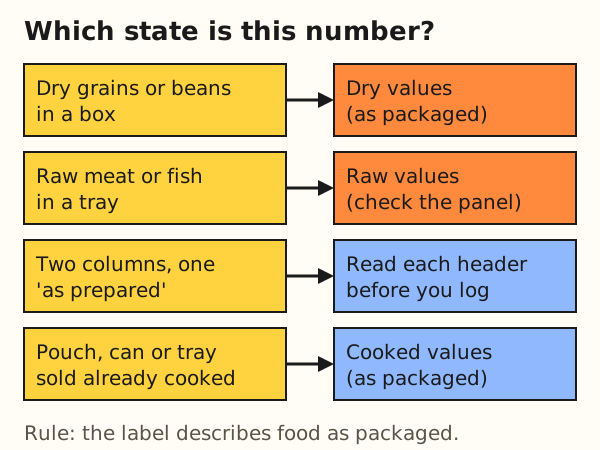
A US nutrition label describes the food as it is sold, unless the label says otherwise with an "as prepared" column or a cooked serving. Dry pasta, rice, oats and dry beans carry dry values, and a raw meat package carries raw values. So the 200 calories (kcal) printed for a serving of dry pasta belong to the dry noodles in the box, not to the plate you eat.
Key takeaways
- The basis is the food "as packaged or purchased" (21 CFR 101.9(b)(9)). A dry grain box describes dry grain.
- Two columns do not always mean dry and cooked. They can also mean per serving and per package, so read both headers.
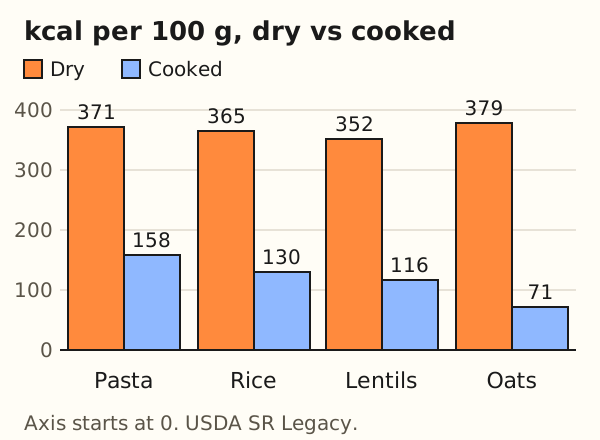
- Divide the label's calories by its serving grams. Dry pasta, rice, lentils and oats run 352 to 379 kcal per 100 g in USDA records. The cooked versions run 71 to 158.
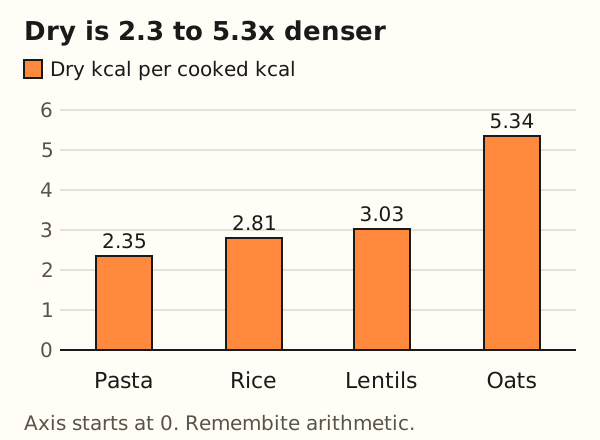
- Dry grains and beans have 2.3 to 5.3 times the kcal per gram of the cooked food. Logging cooked grams against a dry value overcounts by about that factor.
- FDA's own dry and prepared serving pairs (55 g dry or 140 g prepared pasta) are rounded rules. They are close to equal in kcal, not exact.
- These are US rules. Other countries differ, so read the serving line on your own package.
What does a nutrition label describe?
The rule sits in 21 CFR 101.9(b)(9): "The declaration of nutrient and food component content shall be on the basis of food as packaged or purchased". I read it on Cornell LII and again in the eCFR text on 2026-10-16. The paragraph lists three exceptions: raw fish covered under 21 CFR 101.42, packaged single-ingredient products of fish or game meat, and foods packed in water, brine or oil whose liquid packing medium is not customarily consumed. For those, the values describe the food without the liquid.
FDA's label page adds the second half. All the nutrient amounts on the label, "including the number of calories, refer to the size of the serving" (FDA, content current as of 2024-03-05). So a label has two parts you need: what state the food is in, and how much of it one serving is. The serving size is "shown as a common household measure" and "followed by the metric amount in grams", as FDA's serving size page puts it. For logging, the gram figure is the one to trust. A cup of dry pasta and a cup of cooked pasta are different amounts of food. The cups to grams guide shows the gap.
A label can describe more than one form. 21 CFR 101.9(e) says "Nutrition information may be presented for two or more forms of the same food", and that the quantitative information "shall be presented for the form of the product as packaged and for any other form of the product". Boxed mixes use this to show the mix and the prepared dish side by side. The rule asks for equal prominence for both sets of values.
There is a second kind of two-column label that has nothing to do with cooking. The rule behind this is 21 CFR 101.9(b)(12)(i): if a product packaged and sold individually holds at least 200 percent and up to and including 300 percent of the applicable reference amount, the label needs two columns, one per serving and one for the entire package. A tub that holds about two and a half servings shows this. Both layouts have two columns. Only the headers tell you which one you are looking at.
Is each product labeled cooked or uncooked?
Go by the rule above, then by the header. The table gives the basis for each common product and the one thing to check on the pack. No brand is named, because practice differs by brand.
| Product | Label describes | Check on pack |
|---|---|---|
| Dry pasta, rice, oats, dry beans or lentils | The dry food, as packaged | Serving grams. About 3.5 to 3.8 kcal per g means dry. |
| Fresh refrigerated pasta | The pasta as purchased, which still holds water | USDA lists it at 288 kcal per 100 g (FDC 169727), between dry and cooked. |
| Canned beans | The beans as packaged. If the maker states the serving for drained beans, the liquid is left out. | Whether the serving is stated for drained beans. |
| Frozen vegetables | The frozen food as packaged | Column header, in case the maker added a prepared column. |
| Raw meat or fish tray | The raw food as packaged. Fish and game packages follow separate paragraphs. | Panel header and serving grams. |
| Pouch or tray sold cooked | The cooked food as packaged | Cooked values run 0.7 to 1.6 kcal per g in the USDA records above. |
| Mixes and instant packets | The mix as packaged, plus a second column if the maker adds one | Which column you ate: mix or prepared. |
| Prepared meals | The meal as sold | Servings per container against the whole tray. |
I wrote "check the header" wherever I found no rule that settles the answer. A frozen vegetable bag, an instant pouch and a prepared meal are all covered by the same basis, but only the panel shows whether the maker added a prepared column.
USDA keeps the same split in its own data. Instant oats appear as a dry record at 362 kcal per 100 g (FDC 171661) and a "prepared with water" record at 68 (FDC 171662). Both are SR Legacy records I read from the CSV download on 2026-10-16.
How can I tell which state a label means?
Use four checks, in this order.
- Read the serving line. It gives a household measure and a gram weight, such as "1 cup (140 g)".
- Read the column headers. Look for "as prepared", "cooked" or "per container".
- Divide calories by grams. That gives kcal per g. Compare it with the dry and cooked ranges below.
- Cross-check the pack. Servings per container times serving grams should be close to the weight of the package.
The density test works because water adds weight and no energy. In the USDA records, dry pasta, rice, lentils and oats sit at 3.52 to 3.79 kcal per g. Cooked, they sit at 0.71 to 1.58.
Two hypothetical labels show it. A label reading "56 g, 200 calories" gives 200 / 56 = 3.57 kcal per g, which matches dry pasta. A label reading "140 g, 220 calories" gives 220 / 140 = 1.57 kcal per g, which matches cooked pasta. Neither is a real product. Package weight works the same way: 8 servings of 56 g give 8 x 56 = 448 g, a plausible box of dry pasta, while 8 servings of 140 g would be a 1,120 g tub of cooked food.
How much does cooking change the numbers?
A lot, because the same energy is spread over more water. The table pairs the dry and cooked USDA records for four foods. Values are per 100 g from FoodData Central, SR Legacy. The ratio is dry kcal divided by cooked kcal, which equals the weight of cooked food per gram of dry food if the total energy stays put. The raw vs cooked calories guide owns that water and yield idea. This page only needs the ratio to read labels.
| Food | Dry kcal | Cooked kcal | Ratio | FDC ids |
|---|---|---|---|---|
| Pasta, enriched (dry, cooked) | 371 | 158 | 2.35 | 169736 / 169737 |
| White rice, long-grain (raw, cooked) | 365 | 130 | 2.81 | 168877 / 168878 |
| Lentils (raw, boiled) | 352 | 116 | 3.03 | 172420 / 172421 |
| Oats (dry, cooked with water) | 379 | 71 | 5.34 | 173904 / 173905 |
Pasta: 371 / 158 = 2.35. Oats: 379 / 71 = 5.34. The oats record is "cooked with water", so it describes thin porridge. A thicker bowl would sit higher in kcal per g.
For single foods, see the per-food pages: pasta, white rice, oats and lentils. They own the numbers, and this page only uses the pairs.
Why do dry and prepared servings list different grams?
Because FDA sets a reference amount for each form. Table 2 in 21 CFR 101.12 lists "Pastas, plain" at "140 g prepared; 55 g dry" and "Grains, e.g., rice, barley, plain" at "140 g prepared; 45 g dry". For hot cereal it lists "1 cup prepared; 40 g plain dry cereal". The table's footnote defines it: "Prepared means prepared for consumption (e.g., cooked)." If a product has only a prepared reference amount, the dry amount is the amount needed to make it.
This is where dry and cooked servings meet on a label. A maker of dry pasta states 55 g. A maker of cooked pasta in a pouch states 140 g. The table below converts each to kcal with the USDA records above. For oats I used 234 g, the USDA cup weight for cooked oats (FDC 173905).
| Food | Dry g | Prepared g | Dry kcal | Prepared kcal |
|---|---|---|---|---|
| Pasta | 55 | 140 | 204 | 221 |
| Rice | 45 | 140 | 164 | 182 |
| Hot cereal (oats) | 40 | 234 | 152 | 166 |
Pasta: 55 x 3.71 = 204 kcal and 140 x 1.58 = 221 kcal. Rice: 45 x 3.65 = 164 kcal and 140 x 1.30 = 182 kcal. Oats: 40 x 3.79 = 152 kcal and 234 x 0.71 = 166 kcal. The oats row in Table 2 is "hot cereal type", and oats are not named, so I used the closest row. The raw vs cooked guide also lists the pasta and rice pairs.
The pairs differ by 8 to 11 percent in kcal. They are not the same food in two states. FDA's amounts are rounded to what people typically eat. The weight ratio they imply is higher than the USDA ratio for all three foods.
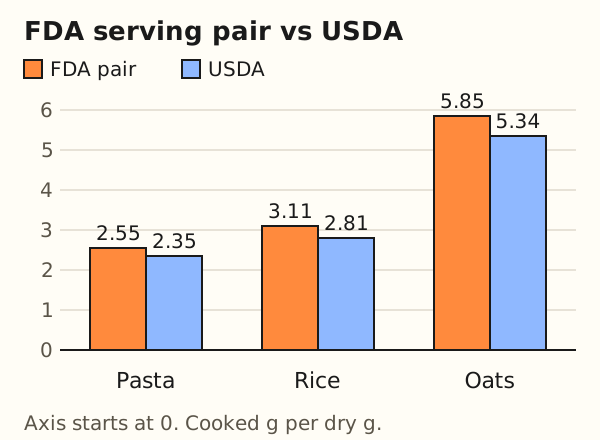
For pasta, 140 / 55 = 2.55 against 2.35 in the records. For rice, 140 / 45 = 3.11 against 2.81. For oats, 234 / 40 = 5.85 against 5.34. If you ever try to convert dry label grams to cooked grams with the reference pair, you overstate the cooked weight by 8 to 11 percent.
How do I log a dry-weight label?
Log it in the state you weighed. You can log either way and land near the same total.
Worked example: A hypothetical box says "serving size 56 g (dry), 200 calories". You weigh 90 g of dry pasta, cook it, and eat all of it. The cooked pasta weighs 212 g on the scale (hypothetical).
- Dry weight times the label value:
90 g x 200 / 56 = 321 kcal - Dry weight times the USDA dry value:
90 g x 3.71 = 334 kcal - Cooked weight times the USDA cooked value:
212 g x 1.58 = 335 kcal - Wrong way, cooked weight times the dry label value:
212 g x 200 / 56 = 757 kcal
The first three land within 14 kcal of each other, about 4 percent. The wrong way is 422 kcal too high, 2.3 times the right total, because 212 g of cooked pasta holds the energy of 90 g of dry pasta.
The 212 g is close to what the table's ratio predicts: 90 x 2.35 = 211 g. Your pot will give a different weight, so weigh it if you want to log cooked grams. Do not convert a cooked weight back to dry, since that needs a guess about water.
Why do label and database numbers differ a little?
Three things move a number even when the state is right.
- Rounding. 21 CFR 101.9(c)(1) says calories are "expressed to the nearest 5-calorie increment up to and including 50 calories" and in 10-calorie increments above 50. A printed 200 stands for roughly 195 to 205.
- Tolerance. Under paragraph (g)(5), a food is misbranded if the composite sample holds calories "greater than 20 percent in excess of the value" on the label. A hypothetical 200 kcal label could test up to 240 kcal and still pass:
200 x 1.20 = 240. Paragraph (g)(6) treats reasonable deficiencies of calories under the labeled amount as acceptable within current good manufacturing practice, so the 20 percent limit is the one that catches excess. The 80 percent rule in paragraph (g)(4)(ii) is written for nutrients such as vitamins, minerals, protein, carbohydrate and fiber. - Which record. A database holds one record per food and a label holds one product. The USDA values here come from a final April 2018 release, while a label describes that maker's recipe.
The third cause is the large one for cooked rice, so the next table shows how many cooked rice records exist.
| Cooked rice record | kcal per 100 g | FDC id |
|---|---|---|
| White, long-grain, enriched | 130 | 168878 |
| White, medium-grain, enriched | 130 | 168880 |
| White, long-grain, precooked or instant, prepared | 124 | 169710 |
| White, long-grain, parboiled, enriched | 123 | 169708 |
| Brown, long-grain | 123 | 169704 |
| Brown, medium-grain | 112 | 168875 |
| White, glutinous | 97 | 169711 |
That is a spread of 97 to 130 kcal per 100 g among these seven cooked rice records. USDA SR Legacy holds others, such as steamed Chinese restaurant rice at 151 (FDC 168912) and a parboiled brown rice at 147 (FDC 173263). A 150 g portion runs from 150 x 0.97 = 146 kcal to 150 x 1.30 = 195 kcal. Two apps can both be right about their record and differ by a third. Add a dry rice record at 365 kcal per 100 g that an app picks for a plain "rice" entry, and the gap grows to 2.8 times.
What can this post not tell you?
- Brand labels. I did not read any product's label, so a maker can choose a layout I did not describe.
- Rules outside the US. I read only 21 CFR 101.9 and 101.12. The UK, EU, Australia, New Zealand and Canada have their own rules. The raw vs cooked guide quotes Australian and EU label text.
- FDA's December 2019 guidance on serving sizes and dual-column labeling. I opened FDA's page for it, but the PDF text did not load, so this post relies on the regulation itself.
- Recipes and mixed dishes. A label for a boxed dinner covers that dinner, not what you add.
- Current values. USDA SR Legacy is a final April 2018 release, and a branded database may hold newer numbers.
Remembite is not affiliated with USDA or FDA.
Nutrition label cooked or uncooked: common questions
Are nutrition facts on pasta for cooked or uncooked?
Dry pasta in a box carries dry values, because the label describes food as packaged. A cooked pouch carries cooked values. Fresh refrigerated pasta is neither: USDA lists it at 288 kcal per 100 g (FDC 169727), against 371 dry and 158 cooked.
Is the serving size on rice dry or cooked?
On a bag of dry rice it is dry. FDA's reference amount for plain rice is 45 g dry or 140 g prepared, so the gram weight on the label tells you which form it uses. Dry rice runs about 3.65 kcal per g and cooked about 1.30.
Do I count calories before or after cooking?
Count in the state you weighed, and use the matching record. The raw vs cooked calories guide gives the full answer, including meat and batch cooking.
Are the calories on oatmeal packaging for dry oats?
For a bag of plain oats, yes, as packaged means dry. FDA's hot cereal reference amount is 40 g plain dry cereal or 1 cup prepared, so check whether the serving grams are about 40 or about 234. USDA lists regular oats at 379 kcal per 100 g dry and 71 cooked with water.
Why do two apps show different calories for cooked rice?
They use different records. USDA alone has plain cooked rice records from 97 to 130 kcal per 100 g, and some prepared-rice records run higher, by grain length, brown or white, parboiled or instant. An app that picks a dry record for "rice" shows 365.
How Remembite handles the state
Your AI does the math. Remembite keeps the record. Say the state in the sentence, for example "56 g dry pasta, as on the label". For foods it can confidently match to a USDA-based reference, Remembite compares the number your AI sends with that reference. If it is far off, it does not save the meal and asks your AI to check with you. It cannot know what state you put on the scale. A food it cannot match is saved as the AI sent it, with only the macro check. The guide to checking an AI calorie estimate covers the density test above.
Free to start. Any paid plan will be announced here before it begins.
Estimates, not medical advice. How the numbers work.
Start your own record
Create a free account with your email, then add Remembite to Claude. Want to look first? Watch Claude log a sample day, no account needed.