How Big Is the Error in Calorie Counts?
Every calorie number is an estimate, whether it comes from a label, an app or an AI assistant. The error has two main sources: the value of the food itself, and the amount you actually ate.
How accurate is calorie counting?
A calorie count is a useful record of what you ate, and it is not a lab measurement. The error shrinks when you weigh food in grams and name its state, and it grows when the amount or the cooking state is a guess.
The short answer: every calorie number is an estimate
A calorie count multiplies a value per 100 g by a weight. Both parts carry uncertainty, and how much depends on how the amount was measured. This article covers where each comes from.
Error source one: the food's own value
Packaged food is the case with a written rule. Under FDA regulation 21 CFR 101.9(g)(5), a food that declares calories on its label is deemed misbranded if its measured content is more than 20 percent in excess of the declared value. There is a proviso: no regulatory action is taken on a value that exceeds the limit by less than the variability generally recognized for the analytical method.
That 20 percent is a ceiling on the excess. It is not a two-way tolerance. For shortfalls, paragraph (g)(6) says reasonable deficiencies of calories under the labeled amount are acceptable within current good manufacturing practice, and it sets no percentage. As an illustration of the arithmetic only: for a label that says 200 kcal, the 20 percent line is 240 kcal (200 plus 40). The proviso tolerates a little more where the analytical method itself varies. Read the full text at Cornell Law School's Legal Information Institute.
For unpackaged food, the value comes from a reference database. USDA FoodData Central is public domain (CC0), and Remembite uses it as its reference data. A reference value describes a typical sample, not the specific chicken breast on your plate. Raw and cooked versions are separate records, so a weight taken in the wrong state is its own error; see raw vs cooked calories.
Error source two: the portion
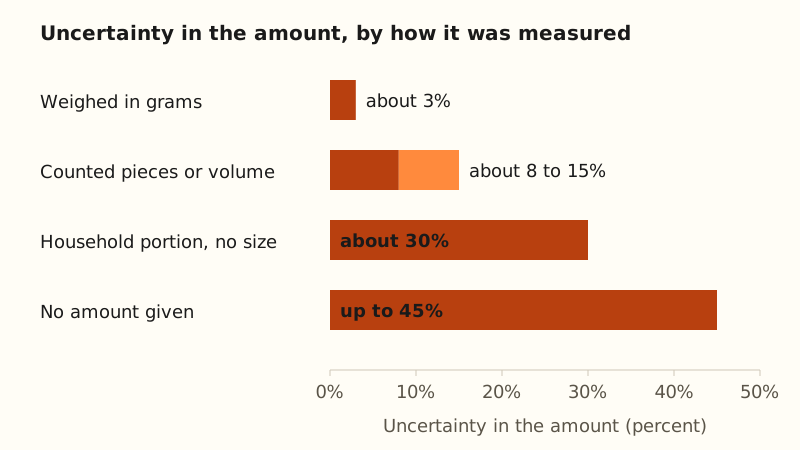
How you measured the amount changes how much you should trust the result. These are the uncertainty levels behind the reference ranges on Remembite's food pages, not a universal standard:
- Weighed in grams: about 3 percent uncertainty.
- Counted pieces or measured volume: about 8 to 15 percent.
- A household portion with no size, such as "a bowl": about 30 percent.
- No amount given: up to 45 percent.
The methodology page lists these. On the reference pages, the range is the estimate plus or minus 1.28 standard deviations, an 80 percent band if the uncertainties follow a normal curve. It describes how well the amount is known. It is not a clinical measurement. The number in your own log is the one your AI sent, after Remembite's check, with no range.
The same food can differ by a factor of almost three
Take 150 g of white rice. The USDA record on the white rice page gives 130 kcal per 100 g cooked and 365 kcal per 100 g dry. The sums below are our own arithmetic, rounded to the nearest kcal:
- 150 g cooked: 1.5 x 130 = 195 kcal.
- 150 g dry: 1.5 x 365 = 548 kcal.
The food did not change between the two lines. What you know about it did. A log that says only "150 g rice" leaves the 353 kcal gap open.
How accurate is calorie counting, then?
Our view as the Remembite team: a count is a useful record of what you ate, and it is not a lab measurement. We give no single percentage for "a typical app", because we have no primary source for one and will not borrow a number. What we can say is how the error behaves. It shrinks when you weigh food in grams and name its state, and it grows when the amount or the cooking state is a guess.
Where does the amount matter most?
Take "200 g of chicken breast". From the USDA records on the chicken breast page, 200 g is 2 x 165 = 330 kcal if it was weighed cooked and 2 x 120 = 240 kcal if raw. A 90 kcal gap comes from one missing word, so say how much and in what state when you describe a meal to an AI.
Meals eaten out are where amounts are hardest to know. The eating out estimates page covers that, and asking an AI or using a catalog compares sources.
Random error in single days shrinks when you average them. See the weekly calorie average guide.
Where does Remembite fit?
Your AI assistant does the math. Remembite is the record behind it. Before it saves a meal, Remembite compares each food it can confidently match to a USDA-based reference, and checks the protein, carbs and fat against the calories. If a number looks far off, Remembite does not save it. It sends a question back to your AI, which asks you to confirm or fix it. That can flag a slip such as dry rice logged as cooked. It cannot know how much you really ate.
See the record
The sample dashboard runs on sample meals and needs no account. To keep your own record, create a free account and add Remembite to Claude.
Estimates, not medical advice. How the numbers work.
Start your own record
Create a free account with your email, then add Remembite to Claude. Want to look first? Watch Claude log a sample day, no account needed.