Ask AI for Calories, Look Them Up, or Keep a Record?
Asking an AI assistant for calories gets you a number in seconds. Looking the food up yourself gets you a number you can trace to a record. A third route keeps what your AI estimated and checks it before it is saved. Which one fits depends on whether you will ever need to look at that number again.
Three ways to get a calorie number
- Ask an AI directly. You describe the meal, and the model writes back an estimate. The number comes from the model itself, and the chat does not keep a log.
- Look it up yourself. You search a food database such as USDA FoodData Central, weigh the food, and do the arithmetic. USDA publishes this data in the public domain (CC0).
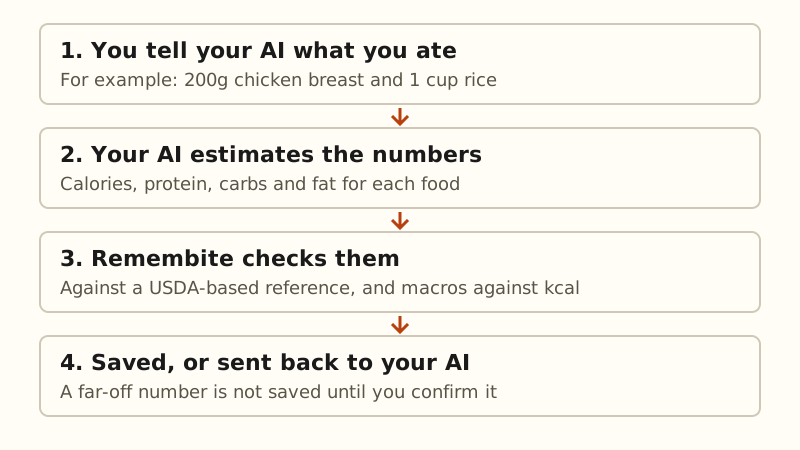
- Let your AI estimate, and keep a record. Your assistant works out the calories and macros and sends the meal to a log. This is how Remembite works (the Claude connector is available now). Remembite compares each food it can confidently match to a USDA-based reference, checks the protein, carbs and fat against the calories, and stores the meal (how it works).
How do the three compare?
The Remembite column describes what a free account does today with Claude. Remembite also works in ChatGPT (beta, via developer mode).
| Ask an AI directly | Look it up yourself | Remembite (your AI estimates, Remembite keeps the record) | |
|---|---|---|---|
| Who works out the number | The model | You, from a USDA record | Your AI |
| A second look at the number | Only if you ask for one | You are the check | Compared with a USDA-based reference where a food matches confidently; protein, carbs and fat checked against the calories |
| When a number looks far off | Only if you spot it yourself | You notice, or you do not | It does not save the number. It sends a question back to your AI, which asks you to confirm or fix it |
| Kept after the chat | No. Totals do not carry over from one chat to the next | Only in your own notes | Every meal in one record, with day totals, history and trends |
| Odd or restaurant foods | The assistant gives an answer; you decide how far to trust it | You search until you find something close | Your AI still estimates. A food with no reference match skips the reference comparison, and the macro check still applies |
| Setup effort | None | Highest: every food, every meal | Create an account and connect Claude or ChatGPT (beta) once |
The limits of the third route are real. Your AI can still get a portion wrong, and Remembite does not make the estimate closer. It makes a bad number easier to catch and keeps the good ones in one place. A free account gives you your own record, and the demo shows the layout on sample meals.
What does public research say about AI estimates?
One peer-reviewed study tested a general-purpose model on meal photographs. Researchers gave ChatGPT-4 114 photographs of Irish meals and asked it to name the foods, estimate their weight, and estimate 16 nutrients (O'Hara et al., Nutrients, 2025).
- Naming foods went well: precision was 93.0%.
- Weight estimates for small meals showed no significant difference from the real weight. For medium and large meals they were underestimated, and the model underestimated weight in 76.3% of photographs.
- Agreement with the known values was poor for 10 of the 16 nutrients.
The authors conclude that further research is needed to train these models for use in nutrition and dietetics and to link them with relevant nutrition databases. Two cautions apply. The study used photographs, not typed descriptions, so it says nothing direct about a sentence like "200g chicken breast and 1 cup rice". And it tested one model at one point in time. We cite it because its recommendation, linking a model to a nutrition database, points the same way as the reference check Remembite runs before saving a meal. For more on what chat assistants can and cannot do with calories, see can ChatGPT or Claude track calories.
When is asking an AI directly fine?
A one-off question is a good fit: roughly how heavy is a restaurant dish, or which of two meals has more protein. You do not need a record for a rough comparison, and nothing is stored. If the number will drive a decision, ask for a range and ask the question twice.
When does a record help?
A record helps when you log every day, or when you may want to look at a number again later. A chat forgets. A log keeps each meal, adds up the day and shows the trend over weeks.
It also helps when a number is wrong. Say your AI sends 600 kcal for 100 g of boiled egg. The eggs page lists 155 kcal per 100 g for a boiled egg, so 600 is almost four times the reference. Remembite does not save it. It sends back a question: is the amount or the food different from what was assumed? Your AI asks you, and the meal is saved once you confirm or fix the number. A chat on its own would have shown the 600 and moved on.
For the steps behind AI food logging, see AI food logging explained. For the AI-only route, see how to count calories with ChatGPT. For where error comes from in any method, see how big the error is in calorie counts. If you are weighing a log against a paid tracking app, see the alternatives guide.
See the record side yourself
The sample dashboard shows Today, History and My foods on sample meals, with no account. To keep your own record, create a free account. See the feature list for what each part does.
Estimates, not medical advice. How the numbers work.
Start your own record
Create a free account with your email, then add Remembite to Claude. Want to look first? Watch Claude log a sample day, no account needed.