Serving Size vs Portion Size: What Labels Mean
A serving size is the amount a label uses to state its numbers. Rules set it from how much people usually eat in one sitting. A portion is the amount you actually eat. The two often differ, and a label serving size is not a recommendation. The FDA says so in plain words: "The serving sizes listed on the Nutrition Facts label are not recommended serving sizes."
Key takeaways
- A serving is the label's unit. A portion is your unit. Every number on the panel, including calories (kcal), refers to one serving.
- Servings per container is net weight divided by serving grams, rounded by label rules. A 340 g pack with an 85 g serving holds 4 servings.
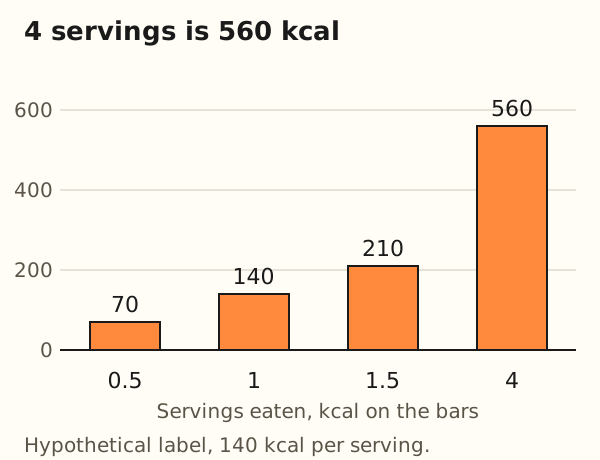
- Eating a whole 4-serving pack means 4 times the per-serving kcal. Eating half means 2 times.
- US packages holding at least 200% and up to 300% of the reference amount carry two columns, one per serving and one per package.
- To log what you ate, scale by grams: grams eaten / grams per serving x kcal per serving.
- Label rules differ by country. This page describes US rules in detail and the EU rule for comparison.
What is the difference between a serving and a portion?
The words get used as if they were one thing. On a package they are two. The serving is printed. The portion is whatever ends up on your plate.
| Term | Who decides | Example, hypothetical | Use |
|---|---|---|---|
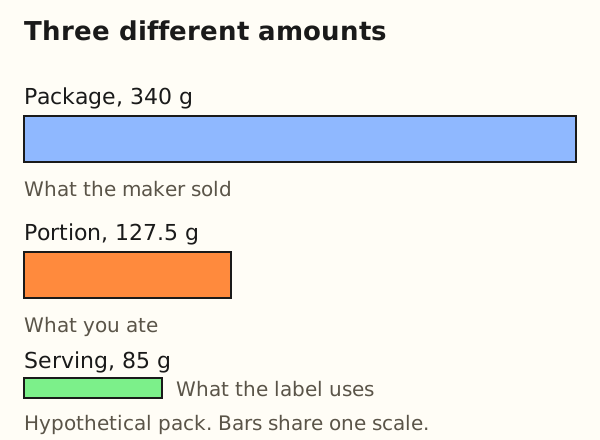
| Serving size | Label rules and the maker | 1 bar, 85 g | Reading the panel |
| Portion | You | 1.5 bars, 127.5 g | Logging a meal |
| Package | The maker | 340 g net weight | Checking the total |
| Servings per container | Net weight / serving grams, rounded | 4 | Scaling up |
The examples use one invented label, a bar sold in a 340 g pack. No real product is meant. The label says 85 g per serving and 140 kcal per serving, and the same numbers run through this whole page.
How is a label serving size chosen?
In the US, the FDA sets standards called Reference Amounts Customarily Consumed (RACCs). A maker converts the reference amount for its product category into a label serving. The FDA's consumer page says: "By law, serving sizes must be based on how much food people actually consume, and not on what they should eat." The FDA's Nutrition Facts label page adds that the serving size "reflects the amount that people typically eat or drink" and "is not a recommendation of how much you should eat or drink."
The regulation itself, 21 CFR 101.12, says FDA calculated the reference amounts "to reflect the amount of food customarily consumed per eating occasion". Makers must "convert the reference amount to the label serving size in a household measure most appropriate to their specific product", so 1 bar, 3 crackers or 1 cup are all possible. Per the FDA consumer update, the reference amounts were based primarily on food surveys from 1977 to 1978 and 1987 to 1988. The updated ones are "now based on 2003 to 2008 data".
The household measure comes with a metric amount. FDA's label page says serving sizes appear "in familiar units, such as cups or pieces, followed by the metric amount", for example grams. For logging, the gram figure is the useful one.
Outside the US
Other regions use a different basis. The EU rule in Regulation 1169/2011 requires nutrient amounts "per 100 g or per 100 ml" (Article 32(2)). A per-portion figure is allowed on top of that, if the portion is "easily recognisable by the consumer", is quantified on the label, and the package states how many portions it holds (Article 33).
| Region | Required basis | Per portion | Source |
|---|---|---|---|
| US | Per serving, from reference amounts | This is the main basis | 21 CFR 101.9, 101.12 |
| EU | Per 100 g or per 100 ml | Allowed in addition, if quantified | Regulation 1169/2011 |
For the UK, the GOV.UK nutrition labelling page says "It is mandatory for nutrition information to be declared on prepacked food". The page text we opened does not state the per 100 g or per portion rule, so this page does not claim one. Read the column headers on your own package: "per 100 g" and "per serving" are different columns with different numbers.
How do servings per container and net weight fit together?
A package states how much food it holds (net weight) and how much one serving is (serving grams). Servings per container links the two. In the US, the regulation requires a "servings per container" statement right after the "Nutrition Facts" heading, with exceptions for single-serving containers and for packages where the number appears in the net quantity statement (21 CFR 101.9(d)(3)(i)).
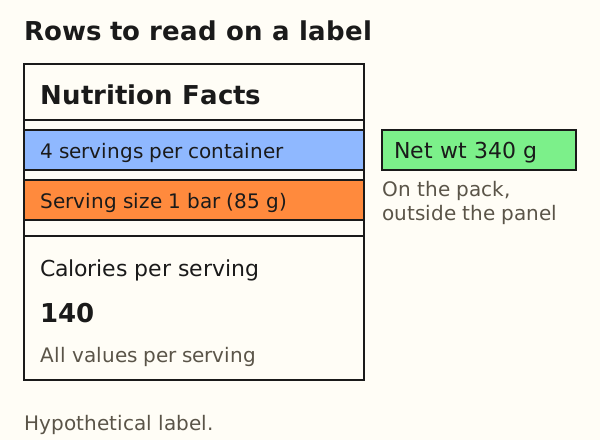
Worked example: the hypothetical pack, 340 g net weight, 85 g serving, 140 kcal per serving.
- Servings in the pack:
340 g / 85 g = 4 servings - Whole pack:
4 x 140 kcal = 560 kcal - Half the pack:
2 x 140 kcal = 280 kcal
The label's per-serving number is a quarter of the pack. The pack total is the figure to use if you ate it all.
Two rules shape what you see. First, a product sold individually that holds less than 200 percent of the reference amount is a single-serving container: "the entire content of the product must be labeled as one serving" (21 CFR 101.9(b)(6)). A small bag you might share is still one serving on the panel. Second, the printed count is rounded. Under 21 CFR 101.9(b)(8)(i), the number of servings is rounded to the nearest whole number, except that amounts between 2 and 5 servings round to the nearest 0.5. A label that reads "about 2.5 servings" shows a rounded count.
What is a dual-column label?
Some packages hold more than one serving but are often eaten in one go. For these the FDA requires two columns. The consumer update says: "This dual-column format is required if a package contains at least two times the reference amount customarily consumed" and "less than or equal to three times the reference amount." Its examples are "a 19-ounce can of soup and 3-ounce bag of chips." The regulation words it as "at least 200 percent and up to and including 300 percent" of the reference amount (21 CFR 101.9(b)(12)(i)), with the extra column listing amounts "for the entire package."
Packages above 300 percent are labeled per serving only. The FDA describes these as "packages that are clearly larger than most people would eat in one sitting".
The two columns cover one serving and the entire package. A two-column panel can also mean dry and prepared food, so read both headers. The guide to dry and cooked labels covers that second kind.
Why does your portion differ from the label?
The label serving comes from typical eating, so it reflects a category average and does not describe you. Three causes are common.
- The reference amount is a category figure. A bar, a bowl of cereal and a yogurt each get a number from the rules. Your plate does not follow them.
- The package can decide for you. A product under 200 percent of the reference amount is one serving by definition, even if you would split it.
- Sharing and leftovers. Part of a pack is eaten by someone else, or tomorrow.
| You ate | Servings | Grams (g) | kcal |
|---|---|---|---|
| Half a serving | 0.5 | 42.5 | 70 |
| One serving | 1 | 85 | 140 |
| One and a half | 1.5 | 127.5 | 210 |
| Whole pack | 4 | 340 | 560 |
The table uses the hypothetical label from above. The kcal column is servings x 140. The same snack is 70 kcal in your log or 560, a factor of 8, and the label never changed.
What should you log?
Log the amount in grams, scaled from the per-serving numbers. If you weighed 100 g of the hypothetical bar:
Worked example: 100 g eaten, 85 g per serving, 140 kcal per serving.
- Servings:
100 g / 85 g = 1.18 servings - Energy:
1.18 x 140 kcal = 165 kcal, or in one line100 / 85 x 140 = 164.7 kcal
The same line works for protein, carbs and fat: scale each per-serving figure by grams eaten / grams per serving.
If a label gives only a household measure, such as "1 bar" or "3 crackers", the metric amount in brackets is the one to scale by. The label rules put a metric figure beside the household measure (21 CFR 101.9(b)(7)), with an exception for single-serving containers. Then use the net weight on the package. For weighing tips see how to weigh food for calorie counting. Without a scale, track calories without a food scale lists six methods. For cups and spoons, see cups to grams.
When there is no label, a USDA-based per 100 g value does the same job. The same grams / 100 x kcal per 100 g arithmetic works on pages such as pasta and oats.
Where does label arithmetic stop working?
- Rounding. A printed servings count can be rounded. A hypothetical pack of 370 g with an 85 g serving holds
370 / 85 = 4.35 servings. The label could show 4.5. At 140 kcal that is4.5 x 140 = 630 kcalagainst4.35 x 140 = 609 kcal, about 21 kcal apart. Net weight divided by serving grams is closer to the pack. - A label is the maker's statement. It is not a measurement of your package. The post on how big the error in a calorie count is covers the evidence.
- Rules differ by country. This page opened US rules and two EU articles. Other countries have their own, and the UK rule is unconfirmed here.
- Reference amounts age. A serving size reflects survey data from the past, 2003 to 2008 in the updated FDA set.
The label gives a unit and the pack gives a total. How many units you ate is your count.
What Remembite does with portions
Your AI does the math. Remembite keeps the record. You tell Claude how many grams you ate and what the label says. Claude works out the calories and macros. Remembite saves the meal and compares foods it can confidently match to a USDA-based reference. A food it cannot match is saved as the AI sent it, with only the macro check. Remembite also works in ChatGPT (beta, via developer mode). Free to start. Any paid plan will be announced here before it begins.
FAQ
Is a serving size the same as a portion size?
No. A serving size is the label's reference amount, set by rules from typical eating. A portion is what you actually eat, which can be half a serving or the whole pack.
Is the serving size on a label a recommendation?
No. FDA states that "the serving sizes listed on the Nutrition Facts label are not recommended serving sizes", and that serving sizes must be based on "how much food people actually consume, and not on what they should eat."
How do I find how many servings are in a package?
Read the servings per container line. If you want a closer figure, divide the net weight by the serving grams: 340 g / 85 g = 4. The printed count may be rounded.
What does servings per container mean?
It is the number of label servings in one package. In the US, the count appears right after the "Nutrition Facts" heading, and counts between 2 and 5 round to the nearest 0.5.
Is the serving size on the label for dry or cooked food?
US labels describe the food as sold, so dry pasta carries a dry serving. Some labels add an "as prepared" column. See are nutrition facts cooked or uncooked.
Estimates, not medical advice. How the numbers work.
Start your own record
Create a free account with your email, then add Remembite to Claude. Want to look first? Watch Claude log a sample day, no account needed.