How to Track Calories Without a Food Scale
You can log calories without a food scale by using six things: the grams printed on a package, the calories posted on a menu, a portion you weighed once and now repeat, a standard measuring cup or spoon, a hand or plate comparison, and an AI that tells you which portions it assumed. The price is a larger error on each meal. That error can be sized and reduced, so the log stays useful for spotting patterns, even though no single meal is exact.
Key takeaways
- Use the most measured method first: the grams printed on a package, then calories posted on a menu, then a portion you weighed once, then cups and spoons, then your eye.
- A portion that is 25 percent larger than you think adds about 51 kcal for 158 g of cooked rice and about 29 kcal for 28 g of cheddar (USDA values, Remembite arithmetic, hypothetical portions).
- In a 2016 study of 67 adults, 80 percent of finger-width estimates for geometrically shaped foods landed within 25 percent of the true weight. Estimates given as cup or spoon volumes, without the cups in hand, did so 29 percent of the time.
- Ask your AI to list the grams it assumed for every item. Correct the ones that do not match your plate.
- A weekly average cancels random errors. It does not cancel a bias such as always pouring more oil than you think.
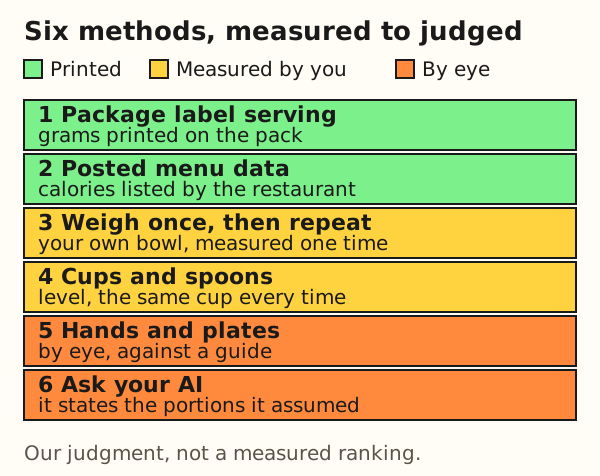
Which no-scale methods work, from most to least measured?
Rank the methods by one question: where does the amount come from? A gram weight printed on a package or a menu comes from someone who measured. A portion you weighed once comes from you, one time. A cup or spoon gives a volume that you convert. A hand or a plate gives a size that you judge. An AI gives a guess that you can inspect. The order below is our judgment, not a ranking measured in a study.
| Method | When it works | Weak spot |
|---|---|---|
| Package label serving | Packaged food with grams and servings per container listed | You eat more or less than one serving and forget to scale |
| Posted menu calories | Chain restaurants that list calories on the menu | Extra sauce, sides and swaps are not in the number |
| Weigh once, then repeat | Meals you eat again: your bowl, your mug, your usual plate | The portion drifts over weeks |
| Measuring cups and spoons | Grains, sauces, spreads, oils | Heaped instead of level, packed instead of loose |
| Hand and plate comparisons | Meat, fish, bread and other compact foods when nothing else is at hand | Hand size varies and irregular shapes fool the eye |
| Ask your AI for its assumptions | Any meal you can describe in words | It guesses a portion unless you give one |
Weighing itself is covered in how to weigh food for calorie counting. This page covers what to do when there is no scale.
How do you use a package label without a scale?
Read the serving size and the number of servings, then multiply. The FDA says the serving size is shown as "a common household measure that is appropriate to the food", followed by the metric amount in grams (FDA, Serving Size on the Nutrition Facts Label, opened 2026-10-16). It also says serving sizes reflect the amount people typically eat, and that a serving is not a recommendation of how much to eat (FDA, How to Understand and Use the Nutrition Facts Label, opened 2026-10-16).
The label gives you grams without a scale. The step that goes wrong is the multiplication. The FDA's own example is a lasagna label that lists one serving as 1 cup: eating two cups doubles the calories and nutrients.
Worked example: a hypothetical granola label lists 4 servings per container, a serving of 3/4 cup (60 g) and 230 kcal per serving. You pour 1 1/2 cups.
- Servings eaten:
1.5 cups / 0.75 cup = 2 servings - Calories:
2 x 230 kcal = 460 kcal - Grams:
2 x 60 g = 120 g
Log 460 kcal and 120 g. If you pour with a cup that is not level, the error comes from the pour, not from the label.
One more point about labels: they describe the food in the state shown on the package, which can be dry, raw or prepared. Are nutrition facts for cooked or uncooked food? explains how to match the label to what is on your plate.
How much error do cups and spoons add?
A level cup or spoon is a good measure when you fill it the same way every time. USDA FoodData Central lists a gram weight for common household portions, so you can convert a cup to grams and then to kcal. The table uses SR Legacy records, the final April 2018 release, read from the official CSV download on 2026-10-16. The kcal column is our arithmetic: grams x kcal per 100 g / 100.
| Food (FDC id) | USDA portion | Grams | kcal |
|---|---|---|---|
| White rice, cooked (168878) | 1 cup | 158 | 205 |
| Peanut butter, smooth (174266) | 2 tbsp | 32 | 191 |
| Pasta, cooked (169737) | 1 cup spaghetti, not packed | 124 | 196 |
| Pasta, cooked (169737) | 1 cup spaghetti, packed | 151 | 239 |
| Cheddar cheese (173414) | 1 oz | 28.35 | 114 |
The two pasta rows come from the same food record. Packing the cup adds 27 g, which is 22 percent more pasta and 43 kcal more (151 - 124 = 27 g, 27 / 124 = 0.22). How you fill the cup matters as much as the food. For a longer treatment, including dry versus cooked cups and milliliters, see cups to grams for calorie counting.
Level the top with a knife and use the same cup every time, so the error stays the same size.
Can you weigh a meal once and reuse the number?
Yes, and it removes the most guessing for the least effort. If you can borrow a scale, or use one at a friend's house or a gym, weigh the portions you eat all the time: your rice bowl, your cereal bowl, your mug of milk, your usual spoonful of oil. Write the gram weight next to the container. From then on, the container is the scale.
Worked example: hypothetical. You weigh your usual rice bowl once and it holds 210 g of cooked white rice. USDA lists cooked white rice at 130 kcal per 100 g, and a level cup at 158 g (FDC 168878; see white rice calories).
- Your bowl:
210 g x 130 kcal / 100 g = 273 kcal - A level cup:
158 g x 130 kcal / 100 g = 205 kcal - Gap if you logged "a cup":
273 - 205 = 68 kcal
The bowl is 33 percent larger than the cup (210 / 158 = 1.33). Logging the bowl at 273 kcal removes a 68 kcal gap every time you eat that meal.
Weigh again after a few weeks, because a bowl you fill by habit can drift. The step-by-step method, including taring and liquids, is in the weighing guide.
Do hand and plate comparisons work?
They work for compact foods and less well for irregular ones. The Human Performance Resource Center, from Human Performance Resources by CHAMP, lists these equivalences (published 2018-01-24, opened 2026-10-16): a fist is about a one-cup serving of milk or raw vegetables, a cupped palm is about a half-cup of cooked fruit, vegetables, beans or starch, an open palm is about a 3-ounce serving of cooked meat, fish or poultry, a thumb is about 2 tablespoons of peanut butter or salad dressing, and a thumbnail is about a teaspoon of butter (HPRC, How to gauge food portion sizes). The page notes that your hand may be larger or smaller than someone else's.
A peer-reviewed test exists for a related idea. Gibson and colleagues asked 67 adults to estimate 21 pre-weighed foods and liquids, each in two portion sizes. For geometrically shaped foods and liquids, 80 percent of estimates made with the finger-width method were within 25 percent of the true weight and 13 percent were within 10 percent. When they judged the same foods as cup and spoon volumes without the cups or spoons in hand, 29 percent were within 25 percent and 8 percent were within 10 percent (Gibson et al., Journal of Nutritional Science, 2016, opened 2026-10-16).
The authors also report that neither method estimated irregular foods such as fish fillets, chicken breasts and beef steaks well; both overestimated them. They suggest using it together with other portion-estimation methods. That is how we use it here: as one row in the ladder, with a wide error, and not as a replacement for a measured amount. For one fixed reference, the roasted chicken breast weight and calories page lists the USDA roasted breast at 172 g and 284 kcal.
How do you log a restaurant meal without a scale?
Start with the menu. In the United States, restaurants and similar food establishments that belong to a chain with 20 or more locations must list calories for standard menu items on menus and menu boards, and must give written nutrition information on request (FDA, Menu Labeling Requirements, opened 2026-10-16). This page covers the US rule only. Posting rules in other countries were not checked.
A posted number covers the standard item as the kitchen builds it. Your meal may differ: extra dressing, a swapped side, a second basket of bread. Log those changes as separate items. When no number is posted, describe the plate to your AI and ask for its assumptions, as in the next section. The page eating-out estimates shows how this works for restaurant meals.
How do you use an AI when you cannot weigh food?
Describe the meal in plain words and ask the AI to list the amount it assumed for each item. The list is the useful part. A calorie total hides the guess inside it. A list of grams shows the guess, and you can change the grams that do not match your plate.
I ate a bowl of cooked white rice, about the size of my fist and a half, and two chicken thighs with skin, roasted. List each item with the grams you assumed, say whether each is raw or cooked, then give calories and macros.
Reply with corrections: "the rice bowl was closer to 200 g", or "I had one thigh, not two". Then ask for the recalculated total.
Your AI app does the math. Remembite keeps the record: it saves each meal, and when a number is far from the USDA-based reference of a food it can confidently match, it does not save it and sends a question back to the AI, which asks you. It works with Claude through a custom connector, and with ChatGPT (beta, via developer mode). For ways to check the AI's answer yourself, see how to check an AI calorie estimate.
How big is the error from a 25 percent larger portion?
Portion error scales with the energy density of the food. We took one common portion of four foods from USDA FoodData Central, enlarged it by 25 percent, and computed the extra kcal. The 25 percent is a hypothetical size of mistake, chosen because it is the threshold used in the Gibson study above. It is not a measured average for any method.
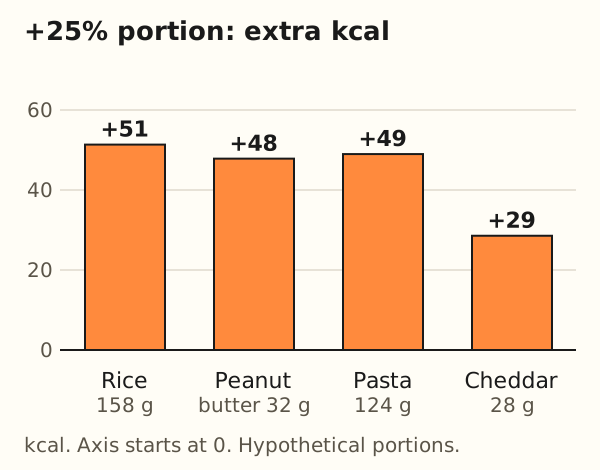
| Food (FDC id) | Logged g | Logged kcal | Extra kcal |
|---|---|---|---|
| White rice, cooked (168878) | 158 | 205 | 51 |
| Peanut butter, smooth (174266) | 32 | 191 | 48 |
| Pasta, cooked (169737) | 124 | 196 | 49 |
| Cheddar cheese (173414) | 28.35 | 114 | 29 |
Worked example: hypothetical. You log 1 cup of cooked white rice (158 g) and the real portion is 25 percent larger.
- Logged:
158 g x 130 kcal / 100 g = 205 kcal - Real portion:
158 g x 1.25 = 197.5 g - Real kcal:
197.5 g x 130 kcal / 100 g = 257 kcal - Missing:
257 - 205 = 51 kcal
Four such meals in a day, all 25 percent too small in the log, would leave out about 200 kcal.
Two things stand out. A small spoon of a dense food costs about as much as a large scoop of a light one: the extra 8 g of peanut butter adds 48 kcal, close to the 51 kcal from the extra 40 g of rice. And human estimates can miss by more than 25 percent. In a 2013 laboratory study, 32 adults with a BMI between 18.5 and 27 estimated how many reference portions were in 33 foods and drinks. They tended to underestimate. Beverages and medium-energy-density foods were underestimated by 30 to 46 percent, while high-energy-density foods were overestimated (Almiron-Roig et al., Appetite, 2013, opened 2026-10-16). Single-unit foods and items labeled as meals or beverages had larger errors than multi-unit foods and snacks.
That study measured how many portions people thought they saw, not grams on a plate, so it does not give an error figure for any method on this page. It does support one habit: be most careful with drinks, where the eye did worst in that study.
Does a weekly average fix the error?
It fixes part of it. Random errors, where some meals are guessed high and some low, partly cancel across a week. A bias, where every meal is guessed low, does not cancel. The chart shows a hypothetical week of daily errors in kcal. The orange bars are random: they sum to 0 over 7 days, and the average size of a daily miss is 117 kcal. The blue bars are a constant -150 kcal each day, such as oil poured by eye and never counted. The weekly mean of that bias is -150 kcal, the same as any single day.
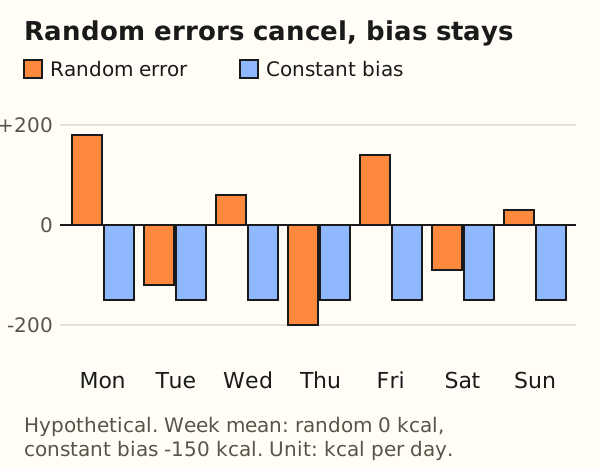
If you can weigh one thing once, pick the item most likely to carry a bias, such as cooking oil, a spread, a sauce or a drink, and keep the rest approximate. The weekly calorie average explains how to compute the average and which days to leave out.
What can these methods not tell you?
No method here matches a scale for a single meal. The numbers in this post show how far a 25 percent miss moves a log, and what a few studies found about estimating by eye. They do not tell you how large your own error is.
- The Gibson study ran in a test setting, and its 80 percent figure applies only to geometrically shaped foods and liquids. This page cites no measurement of how far a level measuring cup is from the true weight, because none was opened for it.
- Averaging does not fix a bias. If you always leave out the cooking oil, the log is low every day, and the weekly mean is low too.
- USDA values describe typical foods. A given brand, ripeness or cooking method can differ from the reference. This holds with or without a scale; see how accurate is calorie counting for the wider picture.
Frequently asked questions
How can I track calories without a food scale?
Use grams from a package label or a posted menu, a level cup or spoon, a portion you weighed once and repeat, or your hand as a rough guide. Ask your AI to list the portion it assumed and correct it. Expect a larger error than with a scale.
Can I track calories without an app?
Yes. A spreadsheet, a notes file or a chat with an AI can hold the log. See macro tracking without an app for a layout you can copy.
How do I track calories without weighing food?
Convert volumes to grams with a table such as USDA FoodData Central, then multiply by kcal per 100 g. A level cup of cooked white rice is 158 g and 205 kcal in the USDA record (FDC 168878). Weigh your usual containers once if you ever get access to a scale.
Can I use an AI to track calories without a scale?
Yes, with one condition: ask it to state the grams it assumed for each item, and fix the ones that look wrong. An AI that returns only a total gives you nothing to check.
How accurate is calorie counting without a scale?
Less exact than with one, and we cannot give a single figure. In one 2016 study, 80 percent of finger-width estimates for geometric foods were within 25 percent of the true weight. For cup and spoon volumes judged without the tools in hand it was 29 percent. Other foods, such as drinks, were harder in a 2013 study.
What does Remembite do with an estimated meal?
Remembite saves the meal your AI logged, charts it over time, and compares the numbers with a USDA-based reference for foods it can confidently match. A food it cannot match is saved as the AI sent it, with only the macro check. A wrong portion that still looks plausible can pass, so the portion questions above stay with you. Free to start. Any paid plan will be announced here before it begins.
Estimates, not medical advice. How the numbers work.
Start your own record
Create a free account with your email, then add Remembite to Claude. Want to look first? Watch Claude log a sample day, no account needed.