How to Estimate Portion Sizes
You estimate a portion by comparing it with something whose size or weight you already know: a bowl or mug you measured once, a countable item such as an egg, or an object from a published portion guide. A miss costs few kcal when the food is light for its size, such as vegetables or rice. It costs more when the food is dense, such as oil, nuts and cheese.
Below: how to calibrate your dishes, what items weigh in USDA data, what two guides say, and how far off people were.
Key takeaways
- Measure a bowl or mug once: water gives its volume in milliliters (mL), and one weighed fill gives the grams of the food you usually put in it.
- USDA lists gram weights for countable items: a medium egg is 44 g, a medium banana 118 g and a medium apple 182 g. Sizes vary, and USDA lists apples from 101 g to 223 g.
- Two published guides give different sizes for the same body part: one says a thumb is about 1 tablespoon of nut spread, the other says about 2 tablespoons. Treat any hand rule as rough.
- One tablespoon too much is about 119 kcal for olive oil and about 13 kcal for cooked rice (hypothetical; USDA lists rice only by the cup, so the tablespoon is our approximation).
- In a 2022 study of 54 adults, 51.6 percent of participants, estimating from photographs, were within 25 percent of the amount served. The authors call it a best-case scenario.
How do you estimate a portion size?
Pick a reference you trust, then judge how much of it the food fills. Three kinds of reference work without a scale at hand. Each has a weak spot, and the table puts them side by side.
| Reference | How to set it up | Best for | Weak spot |
|---|---|---|---|
| Your own dish | Fill with water and read mL once, then weigh one fill of the food | Meals served in the same bowl or mug | Fill level drifts, and one weighing is one sample |
| Countable item | Count the units and multiply by a USDA unit weight | Eggs, fruit, bread slices | Sizes vary within one food |
| Guide object | Compare the food with a fist, palm or thumb from a published guide | Nothing else at hand | Guides disagree, and hands differ |
A bowl of cereal suits your own dish, a breakfast suits counting, and a plate at a friend's house suits a guide object. For logging without a scale in general, see how to track calories without a food scale. This page is about the judging step itself. For the difference between a label serving and the amount you eat, see serving size vs portion size.
How do you calibrate your own bowls and mugs?
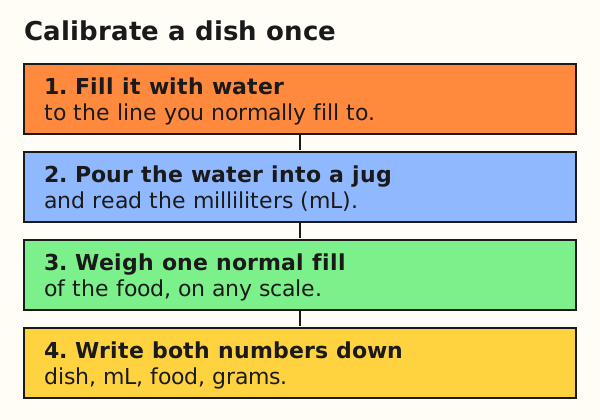
Do it once per dish, in about two minutes, and keep the result. The steps are in the diagram above.
- Fill the bowl or mug with water to the line you usually fill to.
- Pour the water into a measuring jug and read the milliliters.
- Weigh one normal fill of the food you usually put in it, on any scale you can borrow.
- Write the dish, the mL, the food and the grams on a note.
Water helps because it converts volume to weight without a table: USDA lists bottled water with a 1 mL portion of 1 g (FDC 174158). A measuring cup used for nutrition labels is defined as 240 mL, a tablespoon as 15 mL and a teaspoon as 5 mL in US rules (21 CFR 101.9(b)(5)(viii), opened 2026-10-18).
The weighed fill gives grams for one food in that dish. Do not carry the grams to another food: a mug of dry oats and a mug of cooked rice hold very different weights, as cups to grams for calorie counting shows with USDA records. For the weighing step itself, see how to weigh food for calorie counting.
What do common countable items weigh?
The table uses USDA FoodData Central SR Legacy records, the final April 2018 release, read from the official CSV download on 2026-10-18. The kcal column is our arithmetic: grams x kcal per 100 g / 100.
| Item (FDC id) | USDA portion | Grams | kcal |
|---|---|---|---|
| Apple, raw, with skin (171688) | medium, 3 in diameter | 182 | 95 |
| Banana, raw (173944) | medium, 7 to 7 7/8 in long | 118 | 105 |
| Egg, whole, raw (171287) | medium | 44 | 63 |
| Bread, whole-wheat (172688) | 1 slice | 32 | 81 |
| Peanut butter, smooth (174266) | 2 tbsp | 32 | 191 |
| Almonds (170567) | 1 oz, 23 whole kernels | 28.35 | 164 |
| Cheddar cheese (173414) | 1 slice (1 oz) | 28 | 113 |
| Olive oil (171413) | 1 tbsp | 13.5 | 119 |
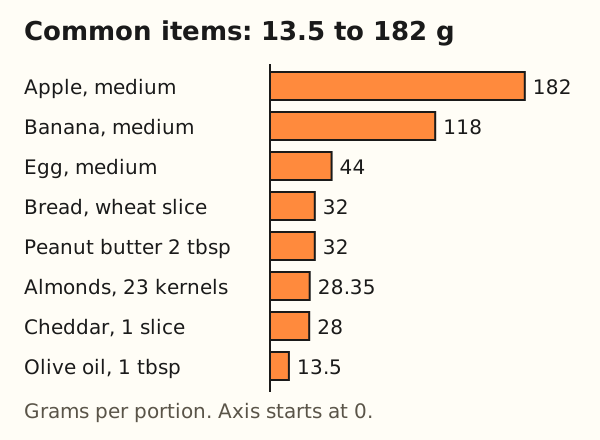
"Medium" is a range. The apple record alone lists four sizes: extra small 101 g, small 149 g, medium 182 g and large 223 g (FDC 171688). Count the item, then ask which size it was. The portion rows do not say how many samples sit behind a weight, so read them as typical values.
The table also shows that weight alone does not tell you the energy. About 28 to 32 g is a slice of bread at 81 kcal, an ounce of cheddar at 113 kcal or two tablespoons of peanut butter at 191 kcal.
What do published portion guides say?
Two guides with hand and object comparisons gave usable detail when we opened them. The Academy of Nutrition and Dietetics page on serving size and portion size (published December 18, 2018, reviewed February 2, 2026) pairs each object with an amount:
- A baseball or an average-sized fist measures about 1 cup.
- A tennis ball or a small scooped handful measures about 1/2 cup.
- A deck of cards or the palm of the hand measures about 3 ounce-equivalents.
- The size of the thumb measures about 1 tablespoon.
- A postage stamp, or the tip of the pointer finger to the first joint, measures about 1 teaspoon.
The page also says to "measure foods regularly to get an idea of what the serving sizes look like" (Academy of Nutrition and Dietetics, Serving Size vs. Portion Size, opened 2026-10-18). That is the calibration habit from the section above.
The table turns four of those objects into grams and kcal with USDA records. The foods are our pick from the food groups the page names, one per object. We read "3 ounce-equivalents" as 3 oz of cooked meat, 85 g, because the part of the page we opened does not define the term.
| Object | Amount stated | Food (FDC id) | Grams | kcal |
|---|---|---|---|---|
| Tennis ball | about 1/2 cup | White rice, cooked (168878) | 79 | 103 |
| Deck of cards or palm | about 3 ounce-equivalents | Chicken breast, roasted (171477) | 85 | 140 |
| Thumb | about 1 tbsp | Peanut butter, smooth (174266) | 16 | 96 |
| Postage stamp | about 1 tsp | Olive oil (171413) | 4.5 | 40 |
Rice is half of USDA's 158 g cup. Peanut butter is half of the 32 g, 2 tbsp row. Chicken is 3 x 28.35 g. Olive oil is the 4.5 g teaspoon row.
A second guide disagrees on the thumb. Human Performance Resources by CHAMP says a thumb about equals a 2-tablespoon serving of peanut butter or salad dressing, and that "your hand might be larger or smaller than someone else's", though it adds that hand size generally tracks body size (HPRC, How to gauge food portion sizes, January 24, 2018, opened 2026-10-18). The Academy page says 1 tablespoon. For peanut butter, that gap is 1 tbsp, about 16 g and 96 kcal (32 g / 2 = 16 g, 16 g x 598 kcal / 100 g = 96 kcal, FDC 174266).
The UK National Health Service says "An adult portion of fruit or vegetables is 80g", and a portion of dried fruit is "around 30g", about 1 heaped tablespoon of raisins (NHS, 5 A Day portion sizes, page last reviewed 19 July 2022, opened 2026-10-18). Those portions exist to count toward 5 A Day, not to count kcal, and most fruit portions are counted as one piece, such as 1 apple or banana, so an NHS portion does not tell you grams or kcal.
Which foods need the most care?
The ones with many kcal per gram. A visual error of the same size costs more in olive oil than in cooked rice, because a gram of oil carries about 6.8 times the energy of a gram of rice (884 and 130 kcal per 100 g). The chart shows eight foods from USDA records.
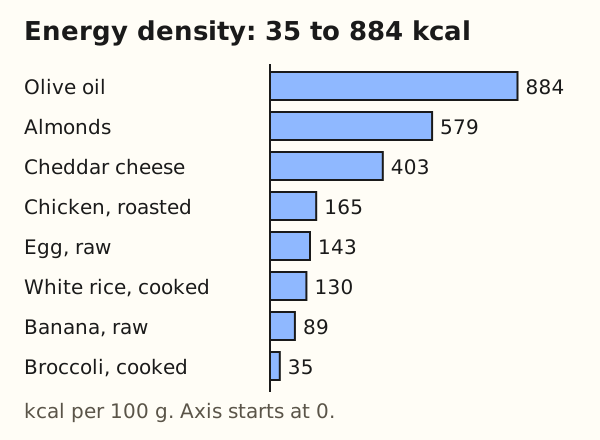
Oils, nuts and cheese sit at the top: a spoon of them is small to the eye and large in the log. If you can weigh or look up one thing, pick the dense one.
Worked example: hypothetical. You misjudge by one tablespoon, once with olive oil poured by eye and once with cooked rice served with a spoon.
- Olive oil, 1 tbsp is 13.5 g:
13.5 g x 884 kcal / 100 g = 119 kcal - Cooked rice, 1 tbsp as 1/16 of the 158 g cup:
158 g / 16 = 9.9 g, then9.9 g x 130 kcal / 100 g = 13 kcal - Gap between the two misses:
119 - 13 = 106 kcal
The same-sized miss is about 9 times larger for the oil. The rice figure is an approximation, because USDA lists cooked rice only by the cup (FDC 168878) and 16 tablespoons make a label cup of 240 mL.
How far off are people?
The size depends on the task. Two studies give a sense of it, and both have limits.
Shinozaki and Murakami asked 54 adults at the University of Tokyo to serve 12 foods in the amount they usually eat, one day, and to estimate those amounts from digital food photographs the next. Across all items, 51.6 percent of participants were within 25 percent of the true amount, 81.9 percent within 50 percent and 93.4 percent within 75 percent. Individual foods ranged from 29.8 percent too low (curry sauce) to 34.0 percent too high (margarine). The authors call their results a best-case scenario because of the controlled setting and the limited variety of foods and tableware, and note that the sample was young and highly educated (Shinozaki and Murakami, Journal of Nutritional Science, 2022, opened 2026-10-18). It used photographs, so it does not measure how well you judge food on a plate.
Sharp and colleagues asked 281 adults to draw the dinner they expected to eat on a 23 cm or a 28 cm paper plate. The abstract reports about 24 percent more food drawn on the larger plates (Sharp et al., Food Quality and Preference, 2019, opened 2026-10-18). People drew a plan, not a meal they ate, and only normal-sized plates were tested. The paper is an author manuscript with inconsistent figures, so we cite only the abstract. The dish may change how much you serve, one more reason to calibrate your own.
Studies of drinks and of the finger-width method are in the no-scale post.
What about restaurants and AI estimates?
At a restaurant you rarely have your own dish. Use a countable item or a guide object, and log extras such as sauce or a side as separate items. The page on eating-out estimates shows how this works for restaurant meals.
With an AI, give the reference you used, so the number it returns carries your assumption.
I ate a mug of cooked white rice, about 250 mL, and two eggs. Tell me the grams you assumed for each item, then give calories and macros.
An answer that lists grams can be checked against your calibration note. How to check an AI calorie estimate covers the other checks. Your AI does the math. Remembite keeps the record. It saves what the AI sent, in Claude or ChatGPT (beta, via developer mode).
What can these methods not tell you?
- Reference objects are rough. The two guides we opened disagree on the thumb, and neither says how exact its comparison is.
- One weighed fill is one sample. A bowl you fill by habit can hold more tomorrow than today.
- No source we opened covers every food. The USDA portion rows are typical values, not your item.
- The two error studies used photographs and drawings. They do not give an error size for any method on this page.
- All kcal figures are USDA reference values. A brand, a ripeness or a cooking method can differ.
Frequently asked questions
How do I estimate portion sizes?
Compare the food with something whose size you know: your own bowl or mug measured once with water, a countable item with a USDA unit weight, or a guide object such as a deck of cards. Be most careful with oils, nuts and cheese.
How much is a serving of cooked rice in grams?
USDA lists 158 g for one cup of cooked long-grain white rice, 205 kcal (FDC 168878). The tennis-ball comparison from the Academy page, about 1/2 cup, is 79 g. See white rice and brown rice for the records.
How do I estimate portions when eating out?
Count what you can count, such as eggs, slices and pieces, and compare the rest with a guide object. Log sauces and sides separately. The eating-out estimates page has the method.
Can I use my hand to estimate a portion?
Two published guides give hand comparisons, and they differ: a thumb is about 1 tablespoon in one and about 2 tablespoons in the other. We could not confirm an official hand rule that is exact, so use your hand as a rough check only.
How do I tell an AI the size of my portion?
Say the reference and ask for the grams it assumed: "a mug of rice, about 250 mL". Correct any gram figure that does not match your calibration note, then ask for the new total.
What does Remembite do with an estimated meal?
Remembite saves the meal your AI logged, charts it over time, and compares the numbers with a USDA-based reference for foods it can confidently match. A food it cannot match is saved as the AI sent it, with only the macro check. Free to start. Any paid plan will be announced here before it begins.
Estimates, not medical advice. How the numbers work.
Start your own record
Create a free account with your email, then add Remembite to Claude. Want to look first? Watch Claude log a sample day, no account needed.