Does Cooking Reduce Calories? What Really Changes
Cooking does not make the energy in food disappear. It changes what a gram weighs, because water leaves or enters the food, and it changes how much fat stays in the food, because fat melts into the pan or oil goes in. For logging, weigh the food, then pick the entry for the same state, raw or cooked, as in raw vs cooked calories.
A third effect is less settled: research suggests cooking can change how much energy the body takes from some foods, and labels and databases generally do not adjust for that.
Key takeaways
- Water: 100 g of raw pork top loin chop is 155 kcal and 100 g of pan-fried chop is 196 kcal (USDA). The cooked gram is denser because water left. Per gram of dry matter, both records sit at about 5.2 kcal.
- Fat: in USDA ARS cooking-yield rows, pan-broiled beef patties lose 1.4% (under 12% fat) to 12.4% (over 22% fat) of their raw weight as fat, and baked bacon loses 32.4%. Fat that leaves the food is energy you do not eat.
- Added fat: 1 tablespoon of olive oil is 13.5 g and 119 kcal. Oil that stays in the food counts as its own item.
- Digestibility: a 2011 mouse study found cooked meat and cooked sweet potato gave more energy gain than raw. It was a small trial, and mice are not people. No correction factor for logging exists.
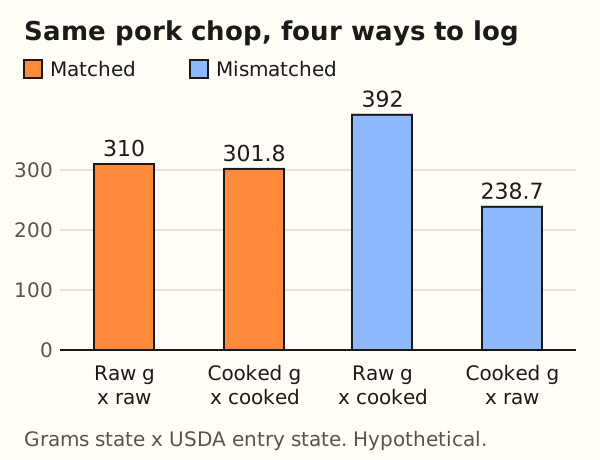
- Worked example: 200 g of raw pork chop logs at 310 kcal as raw and 301.8 kcal as cooked. A raw weight on a cooked entry gives 392, which is 26.5% too high.
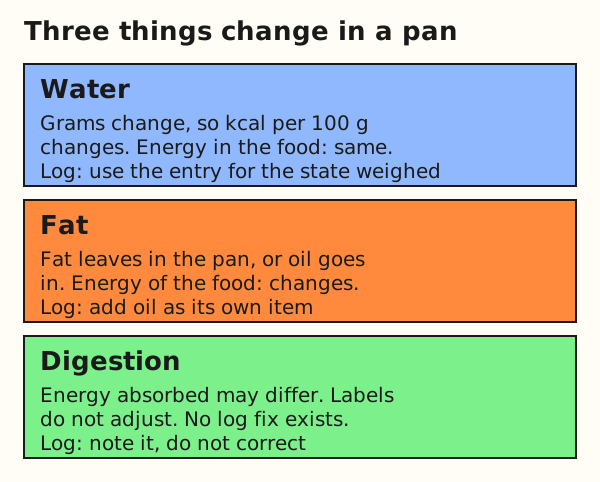
Does cooking reduce calories? The short answer
Water. Meat loses water in the oven and each cooked gram holds more calories. Rice and lentils take up water in the pot and each cooked gram holds fewer. The portion as a whole keeps its energy, so only the per-gram number moves. See water.
Fat. Bacon and fatty ground beef lose fat as they cook. That fat is in the pan, and if you leave it there, the food you eat has fewer kcal. Oil added for frying works the other way. See fat and added fat.
Digestibility. Peer-reviewed work suggests the energy your body gets from a food can differ between raw and cooked. The size in people is not established for any common food. See digestibility.
Why do calories per 100 g change when food cooks?
Food is water plus dry matter, and the dry matter carries the energy. If cooking moves water in or out, the weight changes and the kcal per 100 g change with it. The table below adds a column the raw vs cooked post does not have: kcal per gram of dry matter, which is 100 minus the water. USDA FoodData Central (FDC) SR Legacy records, one pair per food.
| Food and state | kcal per 100 g | Dry g | Dry kcal/g | FDC id |
|---|---|---|---|---|
| Pork top loin chop, raw | 155 | 29.62 | 5.23 | 167839 |
| Pork top loin chop, pan-fried | 196 | 37.38 | 5.24 | 167887 |
| Potato, russet, raw | 79 | 21.42 | 3.69 | 170027 |
| Potato, baked, with skin | 93 | 25.11 | 3.70 | 170093 |
| Lentils, raw | 352 | 91.74 | 3.84 | 172420 |
| Lentils, boiled | 116 | 30.36 | 3.82 | 172421 |
The kcal per 100 g move in both directions. Pork and potato lose water, so kcal per 100 g rise from 155 to 196 and from 79 to 93. Lentils gain water, so they fall from 352 to 116. The last column barely moves: in all three pairs the energy per gram of dry matter agrees within 0.5%. Each pair is two separate USDA records, and the dry-matter columns are our arithmetic.
That makes the portion maths simple. Raw pork has 100 - 70.38 = 29.62 g of dry matter per 100 g and the pan-fried record has 100 - 62.62 = 37.38 g. For the dry matter to match, 100 g raw becomes 100 x 29.62 / 37.38 = 79.2 g cooked. At 196 kcal per 100 g that is 79.2 x 196 / 100 = 155 kcal, the same as the raw 155. The weight moved and the energy did not.
Does cooking meat reduce calories because fat drips out?
Sometimes, yes. Here the energy does leave the food. The USDA Agricultural Research Service (ARS) publishes a Table of Cooking Yields for Meat and Poultry, Release 2. ARS describes the data as "measures of changes in meat and poultry weights resulting from moisture and fat losses during cooking". The rows give the cooking yield, the moisture change and the fat change as percentages, and the number of samples (n). I read them from the Data.gov copy of the table (public domain, CC0).
Neither page defines yield or the two percentages. In all four rows below, moisture loss plus fat loss comes close to 100 minus the yield: for the lean patty 21.25 + 1.4 = 22.65 against 100 - 77 = 23, and for baked bacon 35.53 + 32.37 = 67.9 against 100 - 32 = 68. That suggests the losses are percent of the raw weight, and the yield is cooked weight divided by raw weight times 100. This is Remembite's reading of the columns, not an ARS definition.
| Row and method | n | Yield % | Moisture % | Fat % |
|---|---|---|---|---|
| Ground beef, under 12% fat, patty, pan-broiled | 4 | 77 | -21.25 | -1.4 |
| Ground beef, 12% to 22% fat, patty, pan-broiled | 4 | 73 | -20.82 | -6.22 |
| Ground beef, over 22% fat, patty, pan-broiled | 4 | 69 | -18.18 | -12.39 |
| Pork, cured, bacon, baked or roasted | 3 | 32 | -35.53 | -32.37 |
On that reading, a minus sign is a loss. The fatter the beef, the more fat leaves: 1.4% of raw weight for the leanest patty and 12.39% for the fattiest. The water loss differs by about 3 points between the three. Bacon is the extreme: it keeps 32% of its raw weight, and 32.37 percentage points of the loss are fat.
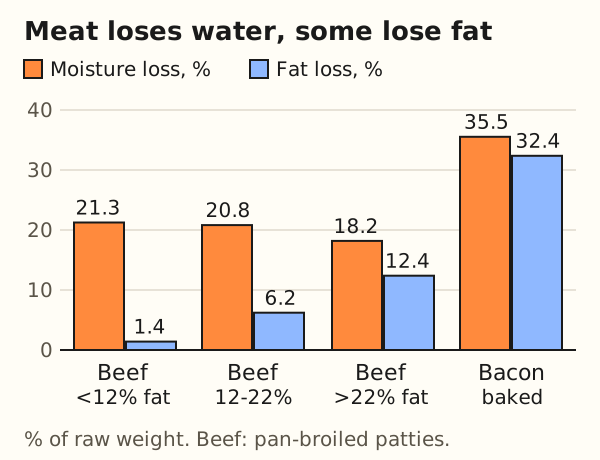
The raw vs cooked post turns the beef patty and bacon yields into kcal and shows that most of the missing energy is the rendered fat. Here the contrast is lean pork. The ARS row for boneless top loin chops, pan-fried (n = 12), has a yield of 77% and a fat change of -0.9. For 200 g raw, that is about 200 x 0.9 / 100 = 1.8 g of fat, or 1.8 x 9 = 16 kcal with the general factor of 9 kcal per gram. The FDC records agree: 200 x 6.94 / 100 = 13.9 g of fat raw and 154 x 7.86 / 100 = 12.1 g cooked. A lean cut loses mostly water, and its energy stays in the meat.
Two limits apply. Fat that leaves the food only lowers what you eat if you leave it in the pan. Spoon the drippings onto rice and the energy is back. Also, fat does not always leave. In the ARS row for pan-fried bone-in pork chops (n = 12), the fat change is +1.1, a small gain. The chicken breast row has a yield of 72% but no moisture or fat figures.
Does frying add calories?
Oil that stays on the food adds energy, and that is a separate effect from the food itself. USDA lists olive oil at 884 kcal per 100 g and one tablespoon at 13.5 g (FDC 171413). That is 13.5 x 884 / 100 = 119 kcal per tablespoon. How much ends up in the food depends on the pan, the food and the method, and the ARS columns do not record the oil used.
For a meal with oil, sauce and several parts, log the oil as its own item, as in calories in a mixed meal. If you do not know how much stayed, log an estimate with a stated amount.
Can cooking change the energy your body gets?
This part is still being worked out, so this section says what two papers found and stops there.
The mouse study. Carmody, Weintraub and Wrangham tested raw and cooked, whole and pounded, lean beef and sweet potato on adult male mice (PNAS, 2011). There were 16 mice in the meat trial and 17 in the tuber trial, and each mouse ate each diet ad libitum for four days. On the tuber diets, mice kept their weight on cooked sweet potato and lost weight on raw. On the meat diets, mice lost weight on every version, yet cooking still gave a better body-mass result, and they ate less of the cooked meat. The authors argue that standard Atwater calculations can miss these effects. They also list limits: mice and humans may differ in how much energy they can extract, the mechanisms are untested, the cost of fighting foodborne microbes was not studied, and a diet of only meat is not expected to suit an omnivore.
The 2009 paper. Carmody and Wrangham, in the Journal of Human Evolution (2009), ask whether cooking reliably raises a food's net energy value. They report that cooking increases starch and protein digestibility and lowers the energy cost of digesting meat, and they predict cooking had substantial evolutionary significance. It is not a per-meal figure you can use in a log.
What labels do. USDA's FoodData Central Foundation Foods documentation states that "most energy values are calculated using the Atwater general factors of 4, 9, and 4" for protein, fat and carbohydrate, with specific factors from USDA Handbook 74 for other foods, and that the data represent physiologically available energy, which it defines as gross energy minus digestive and urinary losses. The page does not describe any adjustment for cooking. US labels follow the same system: 21 CFR 101.9(c)(1)(i) allows the Atwater factors or the general factors of 4, 4 and 9.
None of this tells you to cook or not cook, or gives a number to subtract from your log. The kcal on a database row estimate the energy in the food, not what your body keeps.
Worked example: 200 g of raw pork chop, logged two ways
Worked example: hypothetical. You weigh 200 g of raw, boneless pork top loin chop, pan-fry it, and want to know whether the total depends on the state you log.
- ARS pan-fried yield for this cut, lean and fat (n = 12): 77%. Cooked weight:
200 x 77 / 100 = 154 g - As raw, FDC 167839 at 155 kcal per 100 g:
200 x 155 / 100 = 310 kcal - As cooked, FDC 167887 at 196 kcal per 100 g:
154 x 196 / 100 = 301.8 kcal - Gap:
310 - 301.8 = 8.2 kcal, or 2.6% of 310
The two totals are 8.2 kcal apart. That gap comes from different USDA records and an average yield, not from calories lost in the pan.
The ARS row and both FDC records describe the same cut and method, so the match is as close as these sources allow. The real error sits in the mismatch. Raw grams on the cooked entry give 200 x 196 / 100 = 392 kcal, which is 26.5% above 310. Cooked grams on the raw entry give 154 x 155 / 100 = 238.7 kcal, which is 23% below. Oil added to the pan is a separate item. The weighing guide shows how to weigh before and after.
What should you do when you log?
- Pick the entry that matches the state on the scale, as set out in raw vs cooked calories.
- Check which state a package label describes, as explained in are nutrition facts cooked or uncooked.
- Weigh at one consistent point, as covered in how to weigh food for calorie counting.
What this post cannot tell you
- ARS covers meat and poultry only. There are no fish, rice or vegetable rows. The dry-matter table above comes from FDC records, not ARS.
- Yields vary. The ARS rows are averages over n samples, 3 or 4 here, for one cut and method. Your thickness, heat and time change the result.
- Yield and percentages are our reading. ARS pages do not define them. We read them against raw weight because the numbers add up that way.
- Digestibility is not a correction factor. One mouse study and one paper do not give a number for people. We could read only the abstract of the 2009 paper, so we cite what it states there.
What Remembite does with cooked and raw food
Your AI does the math. Remembite keeps the record. When your AI sends a number that is far from the USDA-based reference of a food Remembite can confidently match, Remembite does not save it and sends a question back to your AI, which asks you. A raw weight paired with a cooked entry is one way to get such a gap, and whether a given gap triggers the question depends on its size. A food it cannot match is saved as your AI sent it, with only the macro check. Free to start. Any paid plan will be announced here before it begins. Remembite works in Claude. It also works in ChatGPT (beta, via developer mode). See the methodology page for the step.
FAQ
Does cooking reduce calories?
It does not remove energy from the food you keep. Water changes the weight, so kcal per 100 g shift, and fat that leaves the food lowers its energy. Cooking may also change what your body absorbs.
Do rice and pasta have more calories after cooking?
They weigh more after cooking because they take up water, and the energy is the same as in the dry amount. 100 g of dry white rice is 365 kcal, and boiled it weighs far more with the same energy. See raw vs cooked calories.
Does cooking bacon or ground beef reduce calories?
Fat leaves both. In the ARS rows, baked bacon loses 32.37% of its raw weight as fat (n = 3) and pan-broiled beef patties lose 1.4% to 12.39% depending on fat grade (n = 4 each). Calories drop only if you leave that fat behind. See bacon.
Does frying add calories?
Oil that stays in the food does. One tablespoon of olive oil is 13.5 g and 119 kcal in USDA data. How much stays depends on the pan and food, so log the oil you add.
Should I log food raw or cooked?
Either, as long as the weight and the entry match. Raw grams go with a raw entry and cooked grams with a cooked one. Details are in raw vs cooked calories.
Estimates, not medical advice. How the numbers work.
Start your own record
Create a free account with your email, then add Remembite to Claude. Want to look first? Watch Claude log a sample day, no account needed.