How Much Does a Chicken Breast Weigh? Raw and Cooked
In USDA's database, a raw, skinless, boneless chicken breast weighs 272 g (9.6 oz), and a roasted breast with bone and skin removed weighs 172 g (6.1 oz, Remembite arithmetic from a half-breast row). Each record describes one standard piece, so the fillet in your fridge can sit well above or below it.
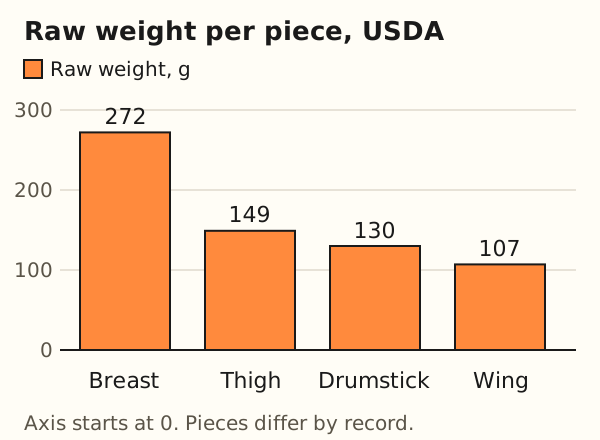
Raw pieces of the other cuts weigh 149 g for a skinless thigh, 130 g for a drumstick and 107 g for a wing. In the USDA ARS cooking-yield rows, roasting leaves 69 to 78% of the raw weight on these four cuts.
Key takeaways
- USDA FoodData Central lists one raw boneless, skinless breast piece at 272 g and one roasted breast at 172 g. They are two different pieces, so 172 / 272 is not a cooking yield.
- Raw pieces: thigh 149 g, drumstick 130 g, wing 107 g. USDA does not say whether these piece weights include bone, and they are not like for like with the bone-in weights in the USDA Food Buying Guide.
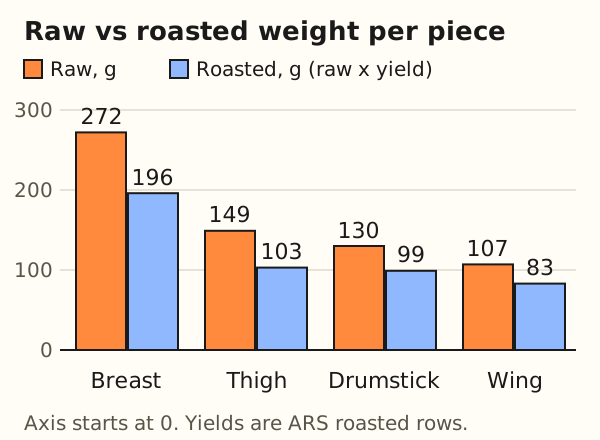
- USDA ARS roasted yields: breast 72%, thigh 69%, drumstick 76%, wing 78%. Raw g x yield % / 100 gives the cooked weight.
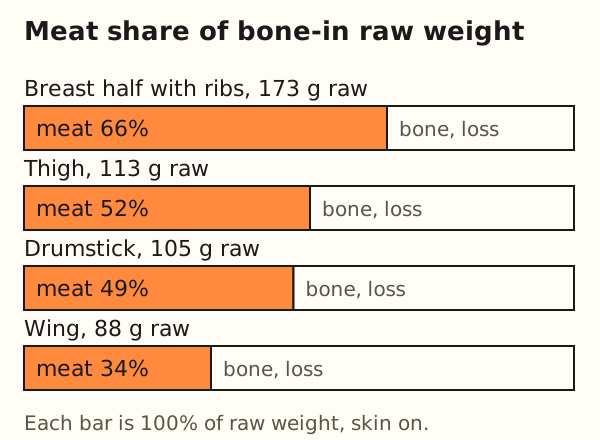
- In a bone-in, skin-on pack, the USDA Food Buying Guide gives 49% of a drumstick's raw weight as cooked meat, 52% for a thigh and 34% for a wing. Log the meat, not the package weight.
- A thick breast and a thin one differ widely. A scale beats any table here.
How much does each cut weigh, raw and cooked?
Table 1 puts the USDA FoodData Central (FDC) portion weights next to a cooked weight calculated from the ARS yield. Grams come first, ounces are in the text.
| Cut and edible part | Raw g | Roasted g | Calculated g | FDC ids |
|---|---|---|---|---|
| Breast, meat only (no skin or bone) | 272 | 172 | 196 | 171077, 171477 |
| Thigh, meat only (no skin) | 149 | 116 | 103 | 173627, 172388 |
| Drumstick, meat and skin | 130 | 96 | 99 | 172373, 173612 |
| Wing, meat and skin | 107 | 85 | 83 | 172390, 173630 |
The calculated column is raw g x ARS roasted yield % / 100, for example 272 x 72 / 100 = 196 g. The ARS rows were measured on meat with skin, so for the skinless breast and thigh the result is an approximation. USDA's own roasted thigh row (116 g) is 13 g above the calculation (103 g).
Where each number comes from, all in the SR Legacy dataset (a historic release, final in April 2018, per the FDC data documentation):
- Raw: the portion rows "piece" (breast 272 g, wing 107 g), "thigh without skin" (149 g) and "drumstick" (130 g, with a second row "drumstick with skin" at 133 g).
- Roasted breast: the row "breast, bone and skin removed" is listed as 0.5 breast = 86 g, so one breast is 172 g (Remembite arithmetic).
- Roasted thigh: "thigh without skin" 116 g, and "thigh with skin" 137 g (4.8 oz).
- Roasted drumstick: the portion row "drumstick without skin" is 96 g, although the record itself is named "meat and skin". A second row, "drumstick with skin (yield from 1 lb ready-to-cook chicken)", is 105 g. Roasted wing: "piece" 85 g.
Why do chicken breasts vary so much in weight?
USDA's own tables list more than one breast size. The Food Buying Guide for Child Nutrition Programs, published by USDA, gives skin-on breast halves at about 7.5 oz and about 6.1 oz, and breast portions at about 3.9 oz and about 5.9 oz. Table 2 shows its bone-in, skin-on rows for the main cuts, converted at 28.35 g per oz.
| Cut, bone-in, skin on | Raw g | Raw oz | Meat g | Share % |
|---|---|---|---|---|
| Breast half with back | 213 | 7.5 | 116 | 55 |
| Breast half with ribs | 173 | 6.1 | 113 | 66 |
| Thigh | 113 | 4.0 | 57 | 52 |
| Drumstick | 105 | 3.7 | 51 | 49 |
| Wing | 88 | 3.1 | 28 | 34 |
Meat g is cooked, boned meat with skin per piece, from the guide's rounded figures (4.1, about 4, about 2, 1.8 and 1 oz). Share % is the guide's yield per pound as purchased, so the two columns can differ slightly.
The guide also tells readers what to do when a piece is bigger or smaller. Its footnote reads: "If the average raw weights of the chicken parts are different from those stated, use the yield information in Column 6 to determine cooked weight." USDA scales by yield, not by piece count.
Compare Table 1 with Table 2. FDC lists a raw drumstick at 130 g and the guide at 105 g, a raw wing at 107 g and 88 g, a thigh at 149 g and 113 g. The two sources describe different things. FDC names its records "meat only" or "meat and skin" and does not say whether these piece weights include bone. The guide lists bone-in pieces as purchased. The numbers are not like for like, so the gap is not a measure of shop variation. The FDC portion rows also carry no sample count and no note on how the piece was chosen.
How much weight does chicken lose when cooked?
The USDA Table of Cooking Yields for Meat and Poultry, Release 2, comes from the USDA Agricultural Research Service. Its page describes the data as "measures of changes in meat and poultry weights resulting from moisture and fat losses during cooking". The Data.gov record lists the file under CC0 1.0, last updated 30 November 2023. The page does not print the yield formula. Remembite reads yield % as cooked weight divided by raw weight, which fits the roasted wing: 85 / 107 = 79% against 78% in the table.
| Cut and method | Yield % | Samples n | Range % | ARS id |
|---|---|---|---|---|
| Breast, roasted | 72 | not listed | 61 to 82 | 5060 (1975) |
| Breast, poached | 77 | not listed | 70 to 88 | 5061 (1975) |
| Thigh, roasted | 69 | not listed | 58 to 79 | 5094 (1975) |
| Thigh, poached | 74 | not listed | 67 to 82 | 5095 (1975) |
| Drumstick, roasted | 76 | not listed | 63 to 87 | 5069 (1975) |
| Wing, roasted | 78 | 1 | not listed | 5103 (2013) |
| Wing, poached | 86 | not listed | 74 to 96 | 5104 (1975) |
All seven rows are described as meat and skin. Six date from 1975 and give no sample count. The roasted wing row, from 2013, rests on a single sample. The ranges are wide: a roasted breast keeps 61 to 82% of its raw weight.
Worked example: two boneless breasts weigh 560 g raw (hypothetical). What might they weigh roasted?
- Table value:
560 x 72 / 100 = 403 g - Low end of the range:
560 x 61 / 100 = 342 g - High end of the range:
560 x 82 / 100 = 459 g
The same raw pack could land anywhere from 342 to 459 g cooked. Use the table value as a first guess and weigh the cooked meat when you can. The raw vs cooked guide explains why the state matters for a log.
How do I log bone-in chicken by its edible weight?
The weight on a bone-in package includes bone and skin. Your log wants the meat you eat. The Food Buying Guide gives the conversion: 1 lb of skin-on drumsticks yields 0.49 lb of cooked, boned meat with skin, and 0.41 lb if you remove the skin. For thighs the figures are 0.52 and 0.43 lb, and for wings 0.34 and 0.26 lb.
Worked example: a pack of 4 skin-on drumsticks weighs 600 g (hypothetical).
- Meat with skin:
600 x 49 / 100 = 294 g - Per drumstick:
294 / 4 = 73.5 g - If you remove the skin before eating:
600 x 41 / 100 = 246 g
Log about 294 g of cooked chicken with skin, or 246 g without. The pack weight of 600 g is about twice the meat weight.
FDC lists a roasted drumstick without skin at 96 g, and the guide gives about 1.5 oz (43 g) of skinless cooked meat from a 3.7 oz bone-in drumstick. USDA does not say whether the FDC piece weights include bone. For a pack of bone-in pieces, use the guide's ratio.
There is a second way that needs no table. Weigh the cooked piece before you eat it, then weigh the bones left on the plate. The difference is the meat you ate, cooking loss included, which is the cooked weight to log.
Where are the calories for each cut?
This page owns weight per piece. The food pages own the calorie (kcal) figures, with the USDA record behind each: chicken breast, chicken thigh, chicken drumstick and chicken wings. Pick the raw or cooked row that matches the state you weighed.
How does Remembite fit in?
Your AI does the math. Remembite keeps the record. Tell your AI "170 g roasted chicken breast" and name the state, raw or cooked, so it can pick the matching USDA entry. Remembite saves the meal. For a food it can confidently match to a USDA-based reference, it does not save the entry when its protein, carbs and fat add up to clearly more calories than the item, or when its calories are far from that reference. Your AI then asks you to confirm or fix it. For the weighing routine itself, see how to weigh food for calorie counting.
FAQ
How much does a chicken breast weigh?
USDA FoodData Central lists one raw boneless, skinless breast piece at 272 g (9.6 oz) and one roasted breast with bone and skin removed at 172 g (6.1 oz). Packs vary, so weigh yours.
How much does a chicken thigh weigh?
FDC lists a raw thigh without skin at 149 g (5.3 oz) and a roasted one at 116 g (4.1 oz), or 137 g (4.8 oz) with skin. A bone-in, skin-on thigh in the Food Buying Guide is about 4.0 oz (113 g) raw.
How much does a chicken breast weigh after cooking?
FDC lists 172 g for a roasted breast. The ARS roasted yield of 72% (range 61 to 82%) turns 272 g raw into about 196 g. The two figures come from different pieces.
How many ounces is a chicken breast?
One ounce is 28.35 g. The FDC raw breast piece, 272 g, is 9.6 oz, and the roasted breast, 172 g, is 6.1 oz. The Food Buying Guide lists skin-on breast halves at about 6.1 to 7.5 oz raw.
Do I weigh chicken raw or cooked?
Either, as long as the log says which. Raw weight goes with a raw entry and cooked weight with a cooked entry. See the raw vs cooked guide.
What can these numbers not tell you?
- They describe a standard piece. The FDC portion rows have no sample count, and USDA does not say whether its piece weights include bone. The Food Buying Guide sizes are for bone-in pieces as purchased, so the two are not like for like.
- The yields are old and wide. Six of the seven ARS rows date from 1975 and give no sample count, and the roasted wing row has one sample.
- The yields cover meat with skin. A skinless breast may behave differently.
- SR Legacy is a historic dataset. Its final release was in April 2018. A branded or pre-marinated pack can differ.
- Your own piece wins. Weigh it raw, or cooked and boned. With no scale, see tracking without a food scale.
Estimates, not medical advice. How the numbers work.
Start your own record
Create a free account with your email, then add Remembite to Claude. Want to look first? Watch Claude log a sample day, no account needed.