How to Count Calories: A 7-Step Guide for Beginners
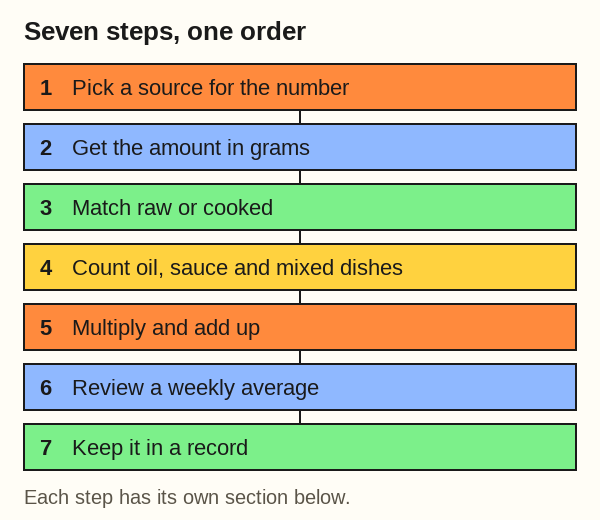
Counting calories means one sum for each food: the amount in grams times the calories (kcal) per gram, then adding the foods together. Do it in this order. Pick a source for the number, get the amount, match the state (raw or cooked), count added fat, add it up, and look at a weekly average. A place to keep the record comes last.
Each step below gives the short rule and sends you to the post that covers it in depth.
Key takeaways
- One food is one line:
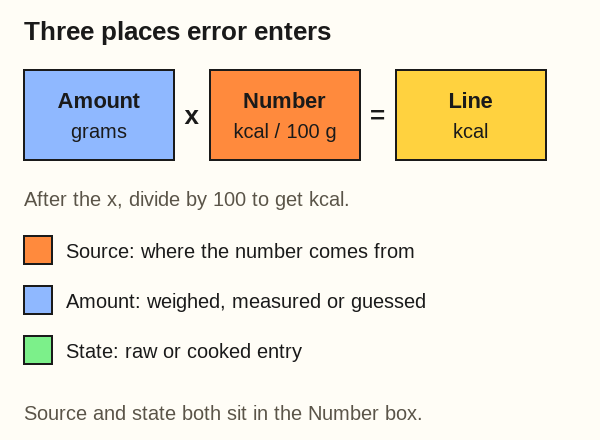
grams x kcal per 100 g / 100. For 60 g of dry rolled oats at 379 kcal per 100 g, that is 227 kcal. - Error enters in three places: the source of the number, the amount, and the state. The state can move a line a lot. The same 60 g of oats is 227 kcal dry and 43 kcal cooked.
- Calories on a US label are for one serving, and the label rounds them to the nearest 5 kcal up to 50 and the nearest 10 above 50.
- Oil, butter and sauces are separate lines with their own gram weights. Fat carries 9 kcal per gram against 4 for protein and carbohydrate.
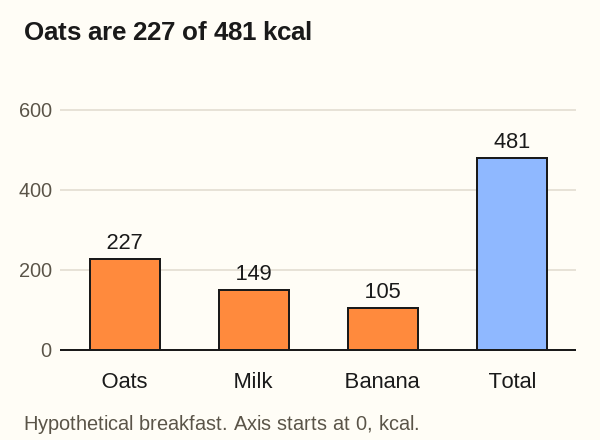
- The hypothetical breakfast below, oats, milk and a banana, adds up to 481 kcal in four lines of arithmetic.
- Judge a week, not a day. This page sets no calorie target.
What are you counting when you count calories?
You are counting energy in food, written as kcal. The FDA describes the label figure this way: "Calories provide a measure of how much energy you get from a serving of this food." This page uses "calories" and "kcal" for the same quantity.
The number for a food comes from one of three places: a package label, a USDA FoodData Central record, or an AI estimate. For US labels, the regulation lets a maker calculate calories with Atwater factors. One allowed method uses general factors of 4 kcal per gram of protein, 4 per gram of total carbohydrate and 9 per gram of fat (21 CFR 101.9(c)(1)(i)). The same factors explain why fat matters in step 4.
Step 1: where does the number come from?
Pick the source before you pick the food. The three sources differ in what they are good for and where they can mislead.
| Source | Good for | Weak spot |
|---|---|---|
| Package label | Packaged food, exactly as sold | Numbers are per serving and rounded |
| USDA FoodData Central record | Plain foods: kcal per 100 g, portion weights | You must choose the right record |
| AI estimate | Foods with no label or record, restaurant meals | Rests on what you told it |
A label is the quickest source when the food has one. The FDA's label guide states that "all the nutrient amounts shown on the label, including the number of calories, refer to the size of the serving." It also says: "The number of servings you consume determines the number of calories you actually eat." Calories are rounded as well. The regulation requires the figure "to the nearest 5-calorie increment up to and including 50 calories, and 10-calorie increment above 50 calories." A printed 140 kcal can stand for any unrounded value within 5 kcal of it.
A label may describe a food as purchased or as prepared. Our post on whether nutrition facts are cooked or uncooked covers that in plain terms.
A FoodData Central record is the usual source for fresh and unbranded food. The USDA FoodData Central documentation describes its SR Legacy dataset as "historic data on food components including nutrients derived from analyses, calculations, and published literature". Each record gives energy per 100 g, and many give the gram weight of a common portion, such as one medium banana at 118 g. Every record has an id, so you can write down which one you used.
Read the full record name before you pick it. Names carry the state and form of the food: "Bananas, raw", "Milk, whole, 3.25% milkfat, with added vitamin D" and "Cereals, oats, regular and quick, not fortified, dry" are all SR Legacy names. A word such as "dry", "raw" or "cooked with water" tells you which scale reading the record fits. A short name from a search box hides that detail.
An AI estimate fills the gaps. The estimate is only as specific as your description: "oatmeal" and "60 g of dry rolled oats" lead to different answers. Give it grams and the state of the food.
Step 2: how do you get the amount?
The number per 100 g is only half the sum. You need the grams. There are three ways to get them, from most to least measured.
| Method | You need | Weak spot |
|---|---|---|
| Weigh | A kitchen scale in grams | Forgetting the bowl or pan |
| Measure | Cups, spoons or a jug | A cup has no fixed weight |
| Estimate | Your eye and a reference size | Nothing checks it |
Weigh. Put the empty bowl on the scale, set it to zero, add the food and read the grams. This gives the amount for a single line of the sum with the least guesswork. The post on how to weigh food for calorie counting has the full method, including soups, oils and packaged food.
Packaged food adds one shortcut. The label gives grams per serving and kcal per serving, so scale by the grams you ate. For a hypothetical label of 85 g and 140 kcal per serving, 100 g eaten is 100 g / 85 g x 140 kcal = 165 kcal.
Measure. A cup is a volume. The grams in it depend on the food. In the SR Legacy portion records, one cup of dry rolled oats is 81 g and one cup of whole milk is 244 g. If you only have cups, convert them with a table instead of guessing. Cups to grams for calorie counting lists common foods.
Estimate. Without a scale you still need a gram figure, so pick a reference size and say so. Size alone can matter. The SR Legacy banana record lists a small banana at 101 g and a large one at 136 g. At 89 kcal per 100 g, that is 101 g x 89 kcal / 100 g = 90 kcal against 136 g x 89 kcal / 100 g = 121 kcal. Read how to estimate portion sizes for ways to pick the reference. For a full list of options without a scale, see track calories without a food scale.
Step 3: should you count raw or cooked?
Match the state of the entry to the state of the food on the scale. Weigh cooked rice and use a cooked-rice entry. Weigh dry rice and use a dry entry. Cooking changes the weight of a food mostly through water gained or lost, so the same grams carry different calories in different states.
| Entry | FDC record | kcal per 100 g | kcal for 60 g |
|---|---|---|---|
| Oats, dry | SR Legacy 173904 | 379 | 227 |
| Oats, cooked with water | SR Legacy 173905 | 71 | 43 |
The cooked record holds 83.61 g of water per 100 g and the dry one 10.84 g, which is why the cooked figure is so much lower. Logging cooked oatmeal as dry oats overstates that line by a factor of more than five. The post on raw vs cooked calories has the ratios for common foods.
Step 4: how do you count oil, sauces and mixed dishes?
Added fat is the line people forget. A splash of oil in the pan, butter on toast or a spoon of dressing carries 9 kcal per gram on the general factors above, more than twice the 4 kcal per gram of protein or carbohydrate. Give each one its own line with a gram weight, weighed in the pan or on the spoon if you can.
A mixed dish is a set of lines. Split it into ingredients, count each, and add them. The item with the most uncertainty sets the error of the whole dish, so spend your care there. How to count calories in a mixed meal walks through a full run, including hidden fat.
How do you count calories in food without a label?
Fresh food, bakery items and restaurant meals usually carry no label. The method stays the same: pick the closest USDA record, state an amount in grams and run the sum.
- Fresh food. Weigh it and use its record, as in the oats example below.
- Bakery and loose items. Pick the closest record, write down which one, and reuse the same choice next time. A consistent choice keeps your week comparable.
- Restaurants. The FDA requires calorie counts on menus and menu boards for "restaurants and similar retail food establishments that are part of a chain with 20 or more locations" (FDA, Menu Labeling Requirements, current as of 12/13/2023). Places outside that rule are not required to post calories, so break the plate into components and estimate each in grams.
The use case on eating-out estimates shows how to handle a restaurant plate step by step.
Step 5: how do you add it up?
Run the sum once per line, then add the lines. The example is hypothetical: no real meal is meant, and the three foods are plain, so each has a USDA record. Records were read from the SR Legacy download (April 2018 release) on 2026-10-18.
| Food | FDC record | Amount (g) | kcal per 100 g | kcal |
|---|---|---|---|---|
| Oats, dry | SR Legacy 173904 | 60 | 379 | 227 |
| Whole milk, 1 cup | SR Legacy 171265 | 244 | 61 | 149 |
| Banana, medium | SR Legacy 173944 | 118 | 89 | 105 |
| Total | 481 |
Worked example: a hypothetical breakfast of 60 g dry rolled oats, one cup (244 g) of whole milk and one medium banana (118 g).
- Oats:
60 g x 379 kcal / 100 g = 227 kcal - Milk:
244 g x 61 kcal / 100 g = 149 kcal - Banana:
118 g x 89 kcal / 100 g = 105 kcal - Total:
227 + 149 + 105 = 481 kcal
The oats are the biggest line at 227 of 481 kcal, 47 percent. A 10 g slip on the scale is 10 g x 379 kcal / 100 g = 38 kcal, and logging them as cooked would remove 184 kcal. Check the largest line first.
The arithmetic is the same for protein, carbohydrate and fat. Scale each per 100 g value by the grams and divide by 100. For protein, the SR Legacy records give 13.15, 3.15 and 1.09 g per 100 g, so the lines are 60 g x 13.15 / 100 = 7.9 g, 244 g x 3.15 / 100 = 7.7 g and 118 g x 1.09 / 100 = 1.3 g. The meal holds 7.9 + 7.7 + 1.3 = 16.9 g of protein.
Write the grams and the record id next to each line in your log. When a week looks odd, you can reopen the largest lines and recheck the source, the amount and the state, in that order.
Step 6: how do you review it?
Read the average of a week, not one day. A single day mixes your real eating with counting error. A week holds most of the ups and downs. Add the calories of the days you logged and divide by the number of those days, not by 7. The post on the weekly calorie average has the arithmetic and the 7, 30 and 90 day views.
Every number in the sum is an estimate. The label is rounded, a record is one entry for a food, not your exact one, and an amount is only as good as how you got it. Treat a total as a range you can compare with itself over time.
Step 7: what do you write it in?
Any place that holds the lines and the totals works. A notebook is enough. A spreadsheet adds totals and a weekly average. A chat with an AI app gives you the arithmetic, but a chat scrolls away, so it needs a record behind it.
Your AI does the math. Remembite keeps the record. You tell Claude what you ate and how much. Claude works out the calories and macros, and Remembite saves each meal and charts it. For foods it can confidently match to a USDA-based reference, Remembite compares the number against that reference. When a number is far off, it does not save the meal and sends a question back so Claude can ask you. A food it cannot match is saved as the AI sent it, with only the macro check. Remembite also works in ChatGPT (beta, via developer mode). Free to start. Any paid plan will be announced here before it begins.
Where does counting calories stop being reliable?
- Every number is an estimate. The source, the amount and the state each add error, and they add up. Rounded labels, a record that is not your exact food and a spoon you did not weigh all leave a gap.
- Counting is a tool. It is a way to write down what you eat. It is not a medical method and it does not suit every person.
- This page sets no target. It does not say how many calories to eat or what a total should be. For questions about diet and health, ask a doctor or a registered dietitian.
- The records here are one dataset. The example uses SR Legacy values read from a local download. A different record for a similar food may list a different number.
FAQ
How do you count calories in food?
Pick a source for the kcal per 100 g, weigh the food, and compute grams x kcal per 100 g / 100. Add the lines for the meal.
How do you count calories in homemade food?
Treat the dish as its ingredients: count each one, including oil, and add them. See how to count calories in a mixed meal.
How do you count calories when eating out?
Use the posted calories if the restaurant is a covered chain, or break the plate into parts and estimate each in grams. The eating-out estimates page shows an example.
How do you count calories without a food scale?
Use a label serving, a cup converted to grams, or a stated reference size, and say which one you used. The post on tracking calories without a food scale ranks the options.
Do you count calories before or after cooking?
Either one, as long as the entry matches the state of what you weighed. Weigh raw and use a raw entry, or weigh cooked and use a cooked entry. See raw vs cooked calories.
How do you count calories with ChatGPT or Claude?
Tell the AI the food, the grams and the state, and ask it to show the arithmetic so you can check each line. Remembite works with Claude and ChatGPT (beta, via developer mode).
Estimates, not medical advice. How the numbers work.
Start your own record
Create a free account with your email, then add Remembite to Claude. Want to look first? Watch Claude log a sample day, no account needed.