Dry to cooked weight chart: rice, pasta, quinoa and more
100 g of dry pasta weighs about 237 g once boiled (USDA Food Buying Guide, spaghetti, 8 minutes al dente), and 100 g of dry white rice weighs about 281 g (implied from USDA FoodData Central records, not weighed in a pot). The energy in the food does not change in the pot. Only the water does, and how much water the food takes up depends on the grain, the cut and the cooking time.
Key takeaways
- 100 g dry becomes 230 to 306 g cooked for the pasta, grains and legumes in Table 1, and 534 g for rolled oats.
- USDA's Food Buying Guide publishes cooked weight per dry weight for pasta, couscous, quinoa, millet, buckwheat and wild rice. It gives rice only in cups.
- Where no weight is published, this page shows a ratio implied by calories per 100 g, and labels it "implied".
- Table 2 lists 50, 75, 100, 125 and 150 g dry so you can read cooked grams without arithmetic.
- Calories for the same food stay the same. Calories per 100 g fall because the same energy is spread over more grams.
- For any other amount, multiply the dry grams by the ratio in Table 1.
What is the dry to cooked weight chart?
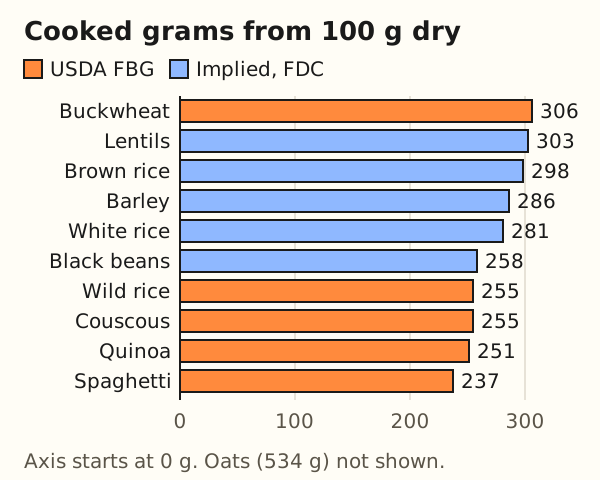
Table 1 gives the cooked weight you get from 100 g of dry food. The ratio is cooked grams divided by dry grams. Spaghetti, for example: 2.37 lb cooked from 1 lb dry gives 2.37 / 1 = 2.37.
Each row uses one source. "FBG" means the USDA Food Buying Guide for Child Nutrition Programs, Section 4 Grains, which states pounds of cooked food per pound of dry. "FDC" means a ratio implied from two USDA FoodData Central SR Legacy records, calculated as dry kcal divided by cooked kcal per 100 g. An implied ratio is not a measured weight.
| Food | Dry (g) | Cooked (g) | Ratio | Source |
|---|---|---|---|---|
| Buckwheat | 100 | 306 | 3.06 | FBG |
| Lentils | 100 | 303 | 3.03 | FDC implied |
| Brown rice, long-grain | 100 | 298 | 2.98 | FDC implied |
| Pearled barley | 100 | 286 | 2.86 | FDC implied |
| White rice, long-grain | 100 | 281 | 2.81 | FDC implied |
| Kidney beans | 100 | 262 | 2.62 | FDC implied |
| Black beans | 100 | 258 | 2.58 | FDC implied |
| Wild rice | 100 | 255 | 2.55 | FBG |
| Couscous | 100 | 255 | 2.55 | FBG |
| Quinoa | 100 | 251 | 2.51 | FBG |
| Penne | 100 | 260 | 2.60 | FBG |
| Spaghetti pieces | 100 | 237 | 2.37 | FBG |
| Millet | 100 | 230 | 2.30 | FBG |
| Oats (regular and quick), cooked with water | 100 | 534 | 5.34 | FDC implied |
Implied rows use SR Legacy kcal per 100 g, dry and cooked: lentils 352 / 116 = 3.03, brown rice 367 / 123 = 2.98, barley 352 / 123 = 2.86, white rice 365 / 130 = 2.81, kidney beans 333 / 127 = 2.62, black beans 341 / 132 = 2.58, oats 379 / 71 = 5.34. Cooked grams are the ratio times 100. The Food Buying Guide cooking methods behind its rows are: spaghetti boiled 8 minutes al dente, penne boiled 14 minutes, quinoa with 2 parts water to 1 part dry, millet with 1-1/2 parts water, wild rice with 2-1/2 cups water to 1 cup dry.
How much is 50, 75, 100, 125 or 150 g dry?
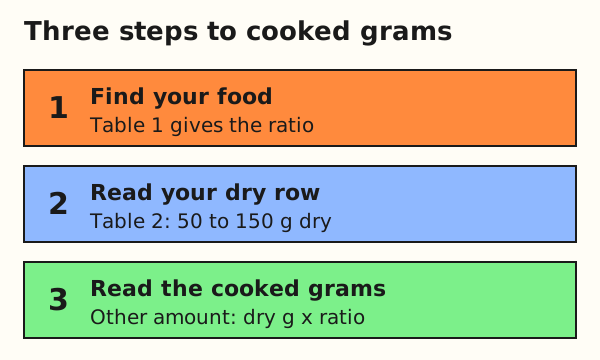
Read your dry amount in the first column and your food across. Each cell is the dry grams times the ratio in Table 1, rounded to the nearest gram. This is our arithmetic: dry g x ratio.
| Dry amount (g) | White rice (g) | Spaghetti (g) | Quinoa (g) | Oats (g) |
|---|---|---|---|---|
| 50 | 141 | 119 | 126 | 267 |
| 75 | 211 | 178 | 188 | 401 |
| 100 | 281 | 237 | 251 | 534 |
| 125 | 351 | 296 | 314 | 668 |
| 150 | 422 | 356 | 377 | 801 |
Example: 75 g of dry spaghetti is 75 x 2.37 = 178 g cooked. For a food or amount that is not in the table, multiply the same way with its ratio from Table 1.
Do calories change when food absorbs water?
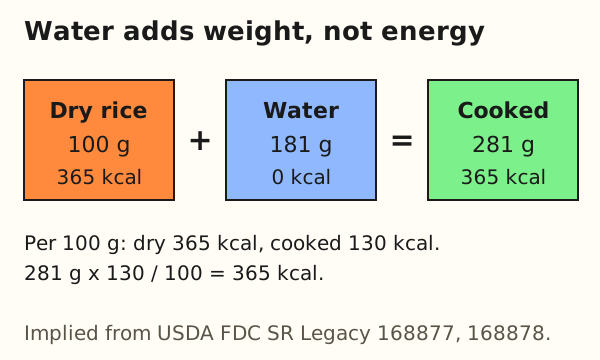
No. The kcal in your dry amount is the kcal in the cooked food that comes from it. Water has no calories, so the cooked weight grows while kcal per 100 g falls. Table 3 uses four foods that are not in the 15-food table of raw versus cooked calories.
| Food | Dry kcal per 100 g | Cooked kcal per 100 g | FDC ids |
|---|---|---|---|
| Couscous | 376 | 112 | 169699 / 169700 |
| Pearled barley | 352 | 123 | 170284 / 170285 |
| Black beans | 341 | 132 | 173734 / 173735 |
| Millet | 378 | 119 | 169702 / 168871 |
The USDA ids are dry first, cooked second. The question of whether cooking itself changes calories is covered in does cooking reduce calories.
What about cups?
The Food Buying Guide gives one rice rule in cups: for regular long-grain enriched white rice, 1 cup dry is about 3-1/4 cups cooked, and for short and medium grain it is about 3 cups. For quinoa it lists 1 lb dry as about 2-1/2 cups dry and 2.51 lb (6-1/2 cups) cooked. A quarter cup of dry quinoa is then about 453.6 / 2.5 / 4 = 45.4 g dry, which becomes 45.4 x 2.51 = 114 g, or about 6.5 / 2.5 x 0.25 = 0.65 cup cooked. Those last numbers are my arithmetic on the guide's figures, not a table row. For the other cups, see cups to grams for calorie counting.
How do you go from a cooked pot to the dry amount?
Worked example (hypothetical): you cook 480 g of dry white rice in one pot, weigh the cooked rice at 1,350 g, and eat 330 g of it. How much dry rice did you eat?
- Share of the pot you ate:
330 / 1350 = 0.244. - Dry equivalent:
480 x 330 / 1350 = 117 g. - Check with energy:
117 x 365 / 100 = 427 kcal, and330 x 130 / 100 = 429 kcal.
You ate about 117 g of dry rice, around 428 kcal, and the two routes agree within 2 kcal.
The full pot method is in weighing raw or cooked. This page only supplies the ratios.
Why do two sources give different ratios?
The two sources used here disagree for several foods, and the size of the gap is a good reason not to treat any one ratio as fixed.
- Quinoa: the Food Buying Guide gives 2.51, while the two FoodData Central records imply
368 / 120 = 3.07. - Couscous: 2.55 from the guide, against
376 / 112 = 3.36implied. - Millet: 2.30 from the guide, against
378 / 119 = 3.18implied. - Pasta agrees: 2.37 for spaghetti from the guide and 2.35 implied for dry pasta (FDC 169736 / 169737).
The Food Buying Guide says its yields are averages from USDA research, and its rows state the water ratio and cooking time. The FoodData Central pair is two separate records, so its ratio carries whatever differences the two records have. The two USDA sources measure differently, so we show both and do not pick one. For quinoa, couscous and millet the FoodData Central cooked records are about 72 percent water by weight (71.6, 72.6 and 71.4 g per 100 g), which is why their ratios come out higher. The rows also show that grain type, cooking time and water ratio differ from food to food.
What can this page not do?
It is a reference table, not a calculator. It has no brand-specific values and no adjustment for your own cooking method.
What are the limits of these ratios?
- An implied ratio comes from two records. It is not a weight measured in a pot.
- Each row uses one source, so rows from FBG and FDC are not directly comparable.
- USDA states the boil time in its pasta rows, so each pasta ratio holds for that time only.
- The Food Buying Guide has no cooked weight for white or brown rice, oats or barley in Section 4 Grains. Dry beans are outside that section.
- FoodData Central SR Legacy was a final release in April 2018 and USDA no longer updates it.
Dry to cooked weight questions
How much does 100 g of dry pasta weigh cooked?
About 237 g for spaghetti boiled 8 minutes al dente and 260 g for penne boiled 14 minutes, both from the USDA Food Buying Guide. The FoodData Central pair for dry pasta implies 235 g.
How many grams of cooked rice come from 100 g of dry rice?
About 281 g for long-grain white rice and 298 g for long-grain brown rice, both implied from FoodData Central records. The Food Buying Guide states rice in cups, not grams.
How much is 1/4 cup of dry quinoa cooked?
About 45.4 g dry, which becomes about 114 g or 0.65 cup cooked. This is arithmetic on the Food Buying Guide figures in the cups section above.
Do oats gain weight when cooked?
Yes. Rolled oats cooked with water imply 5.34 times the dry weight, so 100 g dry is about 534 g cooked. That ratio is implied from two FoodData Central records.
Should I weigh pasta or rice dry or cooked?
Weigh it in the state your calorie number describes, and do not mix the two. The rules are in raw versus cooked calories, and the per-food numbers are on the white rice, pasta, couscous and oats pages. Rows built from USDA records also have their own pages: lentils calories, barley calories and black beans calories.
If you log meals in Claude, the AI works out the grams and calories. Your AI does the math. Remembite keeps the record. Remembite also works in ChatGPT (beta, via developer mode). Whether a label describes dry or cooked food is explained in are nutrition facts cooked or uncooked.
Estimates, not medical advice. How the numbers work.
Start your own record
Create a free account with your email, then add Remembite to Claude. Want to look first? Watch Claude log a sample day, no account needed.